
Clicked on this blog through fear and wanting to learn the newest, trendy takes to propel your AI SEO? GEO? Or whatever the next buzzword is?
Luckily for you, you’ve found the right place…even if it’s mostly to reassure you that the same factors are still incredibly effective now.
In fact, some of the most basic aspects of Technical SEO, in particular, are even more important now than ever.
But that’s not to say that nothing has changed.
So what’s changed due to AI with SEO?
We made a joke at the start of this article, but one thing you can’t ignore is that AI Overviews now dominate many long-tail KW searches and have caused a rise in “zero click searches”.
Even sites like Forbes are now writing articles about “zero click searches” [1] due to the recent AI updates in Google being so significant.
Articles on SearchEngineLand and more report that “zero click searches rise, organic clicks dip” [2] so this much isn’t false information driven by scaremongering.
So, how big of an issue really is this?
Remember “Featured Snippets” and other previous Google search features?
Those that have been in SEO for long enough have seen many changes over just the past 10 years, nevermind since Google’s inception.
In fairly recent memory, Google re-released their “featured snippets” and there were similar concerns about SEO (albeit, less panicking on a global scale).

Image credit: Ahrefs
Back in 2017, Ahrefs released a study showing that featured snippets caused the first organic result to fall below 20 percent [3]. Many site owners and companies at this time panicked too. But as always, SEO didn’t die or cease to exist as a marketing channel.
Funnily enough, as I write this blog (November 2025) I’ve seen the return of featured snippets replacing AI Overviews:

The above is seen for the long-tail KW “what is a multivitamin”, proving that no-one has a crystal ball when it comes to SEO and future updates. Might we still see the return of featured snippets at full force replacing AI Overviews? Who knows.
Think of AI Overviews as the “evolution” of featured snippets
Perhaps the least intimidating way of thinking about AI Overviews, is simply as an evolution of the old featured snippets.
SEO continued to thrive as a marketing channel back then, with there even ways you could game and “steal” featured snippets at that time too, making being shown 1st on Google easier than ever.
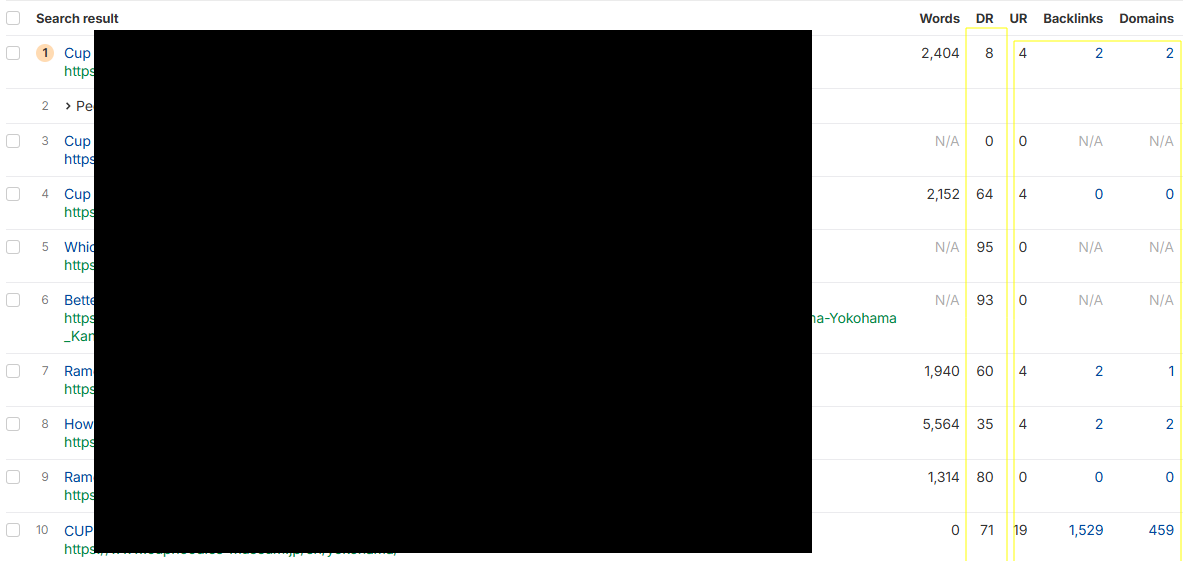
The above screenshot shows one of my test sites ranking #1 for a KW, at the time in a featured snippet, with much lower “DR” than the other ranking sites.
Back then, the key was to simply copy and paste the exact paragraph that was showing in the featured snippet, to include that paragraph right at the top of your page inside a <div class> box or other html feature like an accordion, then have an equal or more “UR” via backlinks. And boom, you’d beat competitors to the featured snippet almost every time.
Anyway, without further ado, let’s look at my top 5 SEO factors everyone should be hitting to “please” Google’s AI and LLMs:
1. Technical SEO: Schema, Hreflang etc.
My “SEO test” I’ve mentioned above was interesting for many reasons, least of all because Google rewarded duplicate content…which they say they punish…
Anyway, getting back to the point, the main thing to remember is that Google bots ultimately crawl pages and feed the algorithm - the bots read content in their own way, that’s clearly different to how humans read a page on a website.
So how can we emphasise paragraphs to make it as important as possible to a bot? By making as much use of technical aspects and feeding Google bots as much information as possible in formats they prioritise.
In particular, this includes Schema.
As all SEOs know, schema has always been important in helping Google’s algorithm join the dots to understand “entities”; people, companies, and so on.
Even before the Google AI updates, all websites should have had schema incorporated onto their site for extra trust signals and to help Google boost your site knowing you were “real”.
I’ve personally helped deliver numerous “knowledge panels” for authors and website owners using mainly schema (and a few other things). And every time it’s helped keep those websites stable since it helps Google trust those websites.

The above shows a screenshot of an author and website owner in the Supplements niche, known as one of the most hostile online for violent Google updates and ranking fluctuations. After all updates, that site is often the only non ecommerce website still ranking for BOFU (Bottom of Funnel) KWs, continuing to earn affiliate commission as a result.
Many SEOs have confirmed Schema is Essential for AI Overviews
As well as through our own SEO audits for some of the leading brands in a range of niches I’ve conducted during my time at ICS, it’s also been confirmed on the likes of SearchEngineLand that: “Only [pages] with well-implemented schema appeared in an AI Overview” in an SEO test conducted by Molly Nogami & Ben Tannenbaum [4].
I’m still surprised to see some of the biggest corporations on earth with websites lacking correct implementation of schema, hreflang tags and more, ignoring the fundamentals of SEO and going straight to the more exciting creative campaigns.
Anyway, before I continue that rant…all of this helps reinforce my belief that I shared at the start of this blog: it really is the basics/fundamentals of SEO still being rewarded. Every website, especially big corporations, should absolutely implement schema, hreflang tags and other fundamental factors.
2. Digital PR for Brand Mentions (and, of course, backlinks)
One of my favorite marketing channels is Digital PR.
I’ve seen some truly awesome, creative campaigns carried out by brands and it always puts a smile on my face seeing new ways of obtaining brand mentions and backlinks in the biggest publications online.
Again, I’m revealing no secrets when I mention that Digital PR has been important for a long time to help SEO. Since you can’t buy links from the likes of BBC and more, earning them by providing journalists with high value content became the top method of obtaining them.
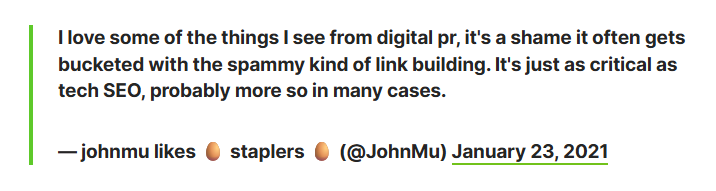
Image credit: https://www.searchenginejournal.com/john-mueller-praises-digital-pr/393464/
Even the likes of John Mueller (of Google at the time) had complimented Digital PR as a means to obtain top tier backlinks…although he’s since deleted his tweet.
ICS Case Study: Supplement Clinical Trial
This will seem extremely biassed now that I’m back at ICS, but my personal favorite Digital PR campaign is one that both myself and ICS worked together on.
I had grown a start up supplements company revenue, as the Head of SEO, significantly to close to £10m within 2 years and had earned budget to help further SEO growth. So, naturally, I reached out to an agency I knew extremely well having worked there - ICS.
After freestyling ideas, we found that conducting a clinical trial at a leading university in the UK would not only deliver great exposure through brand mentions (and backlinks), but also act as an incredible conversion tool as the ultimate way to “prove” that our supplement genuinely worked.

This clinical trial benefitted every marketing channel and significantly improved CVR
Anyone who’s read any clinical trials before will know PubMed as the leading online journal. And Google certainly knows this too.
Due to the clinical trial being published on the likes of PubMed and more, Google now actively uses the information from it to generate AI overviews for important queries in the customer buying journey such as “does [product] work” and more.
This clinical trial benefitted every marketing channel, from SEO to email marketing. Since many self-confessed “biohackers” actively research using PubMed and read clinical trials, this Digital PR campaign also helped “evangelise” even the toughest skeptics - significantly boosting CVR.
Bottom Line: As a Digital Marketer who’s created his own products and led different companies to significant growth within short time frames, I know how important “closing the deals” are after delivering the traffic via organic and paid channels.
Conversion tools such as a clinical trial proving that your product works is invaluable, to the point that customer service personnel can simply send one link to skeptical, potential customers to show it works without sending an unverified paragraph of text.
3. Publishing Different Content Types Across Key Platforms
While many people think SEO is more difficult due to the recent AI updates, I believe that Google has made things potentially easier than ever - due to showing you exactly which sources it trusts and takes information from.
Since we’ve been on the topic of supplements throughout this article, I’ll stay on topic; if you Google queries such as “most reliable [type of product]” etc, you’ll no doubt see an AI overview generated to answer you.
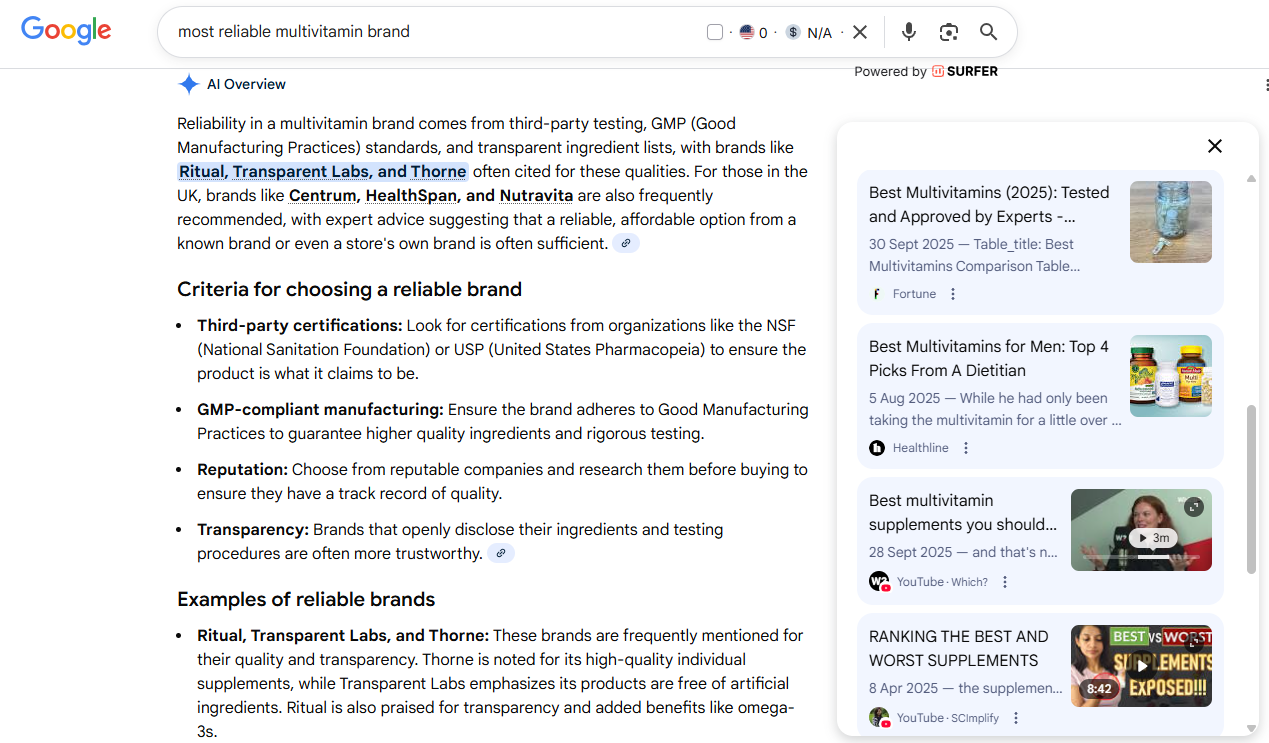
On the right of all AI overviews (on desktop), you’ll then see many sources that Google has used to provide information to you, which includes both articles and YouTube videos.
Now more important for SEO to work with Social Media, Digital PR and other teams
As a result of what we’re seeing, it’s now more important than ever for SEO teams to work with social media and other departments for content creation.
In the screenshot shown above, it’s clear that “Which?” have really nailed this by having their YouTube video featured in the bar - meaning Google has almost certainly used it as a reference point.
Not only that, in the same sources, their article “best multivitamin supplements 2025” has also been used, effectively giving Google 2 sources for information as an expert.
While “Which?” are long established in terms of credibility to both humans and Google, it’s important to remember what helps make any site an “expert” in Google’s algorithm…which leads me nicely onto my next point…
4. Backlinks and Brand Mentions
Since the beginning of time in Google’s algorithm, backlinks have been a key “trust signal” and direct ranking factor.
And…Guess what? This still hasn’t changed with the “new age” of GEO (or AI SEO etc), again proving that things haven’t really changed as significantly as some might think.
However, while “brand mentions” without backlinks may have been seen to hold less value for SEO, AI overviews have now increased their importance (albeit, any brand mention with a backlink is still the perfect scenario).
“Brand Mention Decay”
After conducting audits for some of the biggest brands across several niches, I found that obtaining fresh backlinks via Digital PR and other HQ link acquisition tactics might be more important than ever.
Let’s search into a different niche to help prove this point.
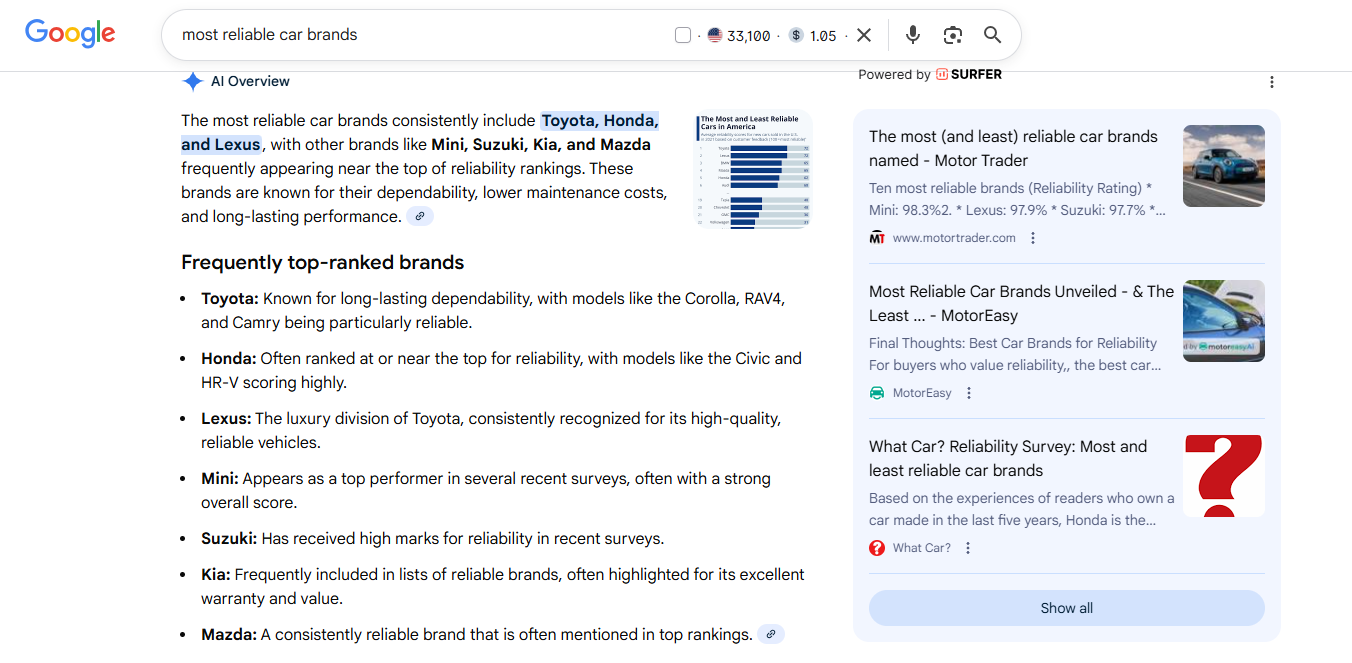
When google searching “most reliable car brands”, you can see that there has been a recent survey conducted and shared across multiple online publications.
The survey that Google AI is pulling information is from “What Car?” in association with MotorEasy, with both sites being the top source in the right hand side bar (as you can see in the above screenshot).
What’s interesting about this (but not new knowledge for many SEOs that always knew) is that Google prioritises fresh, new content. To the point where there is a single “older” survey conducted by “Driver Power” that has been acknowledged by Google, but not really used in the AI overview.
To put that into perspective, the “WhatCar?” survey was published in October 2025, while the “Driver Power” survey was published in July 2025.
As a result, it’s clear that there is a constant need for brands to be pushing for new, fresh content to Google and other LLMs and keep being featured on as many top-tier publications as possible - to keep being “top of the pile” for AI overviews features.
5. You Still Should Have a Blog and cover Brand KWs as much as possible
I’ve seen a rise in the belief that, because AI overviews have taken over long-tail KWs that you don’t need to be publishing any long-tail KW blogs anymore, with some even going to the extreme to say you don’t need a blog due to AI updates.
However, while pumping out hundreds of content without any plan or direction has never been a good idea, it’s still worth updating/reoptimising blogs and publishing new content that follows specific SEO strategies.
In fact, you can now argue that brands having their own blog to “feed” LLMs data as the “source of truth” is now more important than ever.
Again, through performing many audits of companies, I’ve seen that some household name brands are being beaten to their own brand KWs simply due to not covering the topic in enough detail - while 3rd party sites have done so and are being prioritised by Google in its AI overviews.
To get more specific without revealing any brands, one example is where a company hadn’t published enough company information about themselves (eg. a company timeline) to feed to Google, such as when they were established and all key/important events up to the present.
However, there was one third party blog that had published a specific post containing concise information on the topic about the brand and was being chosen in AI overviews, beating the actual brand for their brand KWs in AI Overviews.
Along with YouTube videos and wiki-style sites, Google’s AI overview was generating content almost exclusively from 3rd party sources - and you can imagine how tricky things can become without official, verified information from brands themselves being shown to the public en masse.
As a result, while there is a rise of zero-click searches for long-tail KWs due to AI overviews…don’t forget that Google’s AI still actively chooses what to use in its AI overviews from long-tail KWs, which can generate more brand searches if you’re featured in them.
As the saying goes: you need to be in the race to win it, and you’re not in the race without a blog/capacity to publish targeted long-form content.
Conclusion: No Need to Panic, SEO is still…SEO

Image source: https://www.pexels.com/photo/don-t-panic-text-on-toilet-paper-3991793/
With the recent Google AI updates, especially AI overviews, and the rise of zero-click searches, it’s no surprise that many people are panicking about what the future holds for SEO.
But for anyone who has been in SEO long enough, this moment feels familiar. We saw the same fear during Panda, Penguin, the Medic update… the list goes on. Each time, some websites were effectively “erased,” yet the best SEOs and affiliate marketers adapted, rebuilt, and found new ways to win.
The same applies today.
Yes, AI Overviews will create more zero-click searches. But the demand from users behind those searches don’t vanish into thin air like in Avengers: Infinity War. They still need answers; Google is just changing the way those answers are delivered.
In this new landscape, the goal is to appear in AI Overviews and benefit from the brand exposure they bring. Users who see your brand mentioned - even if they don’t click immediately - often seek you out afterwards. And because AI Overviews summarize information up front, that traffic arrives more pre-qualified than ever.
We didn’t rename SEO to “Penguin SEO” or “Panda SEO” after previous updates, even though those changes were massive. So let’s stop with the scaremongering and the urge to rebrand SEO with every new AI feature.
SEO is still…SEO. It’s simply evolving, as it always has.
References:
[2] https://searchengineland.com/zero-click-searches-up-organic-clicks-down-456660
[3] https://ahrefs.com/blog/featured-snippets-study/
[4] https://searchengineland.com/schema-ai-overviews-structured-data-visibility-462353
Similar Posts