Travel SEO Test: I sent Real Customers to a Restaurant near Tokyo as a UK-based SEO Pro

I’m always surprised by how cynical non-SEOs are when it comes to SEO. I see skepticism around organic traffic and whether online views actually convert to paying customers quite commonly on LinkedIn.
Ahead of ITB Berlin 2026, one of the largest travel and hospitality events in the world, I thought it’d be a good time to share one small example of how international SEO can make a difference in the ultra-competitive world of hospitality - at crazy geographical distance.
Since I started my journey in SEO by creating my own affiliate website almost immediately and making my first affiliate sales within 3 months (and seeing “real money” via affiliate commission payments), I never questioned the value of organic traffic coming from the right intent KWs.
That being said, I’d always worked with B2C FMCG products and Tech SaaS products/subscriptions where customers could buy online and have products shipped almost anywhere in the world.
So, I’d always been interested in other niches that aim to send physical customers to retail stores or restaurants.
Shortly after one particular visit to see my family in Japan, my sister and her partner opened their Italian restaurant just outside of Tokyo; this presented me with the perfect opportunity to see whether I could send physical customers to their restaurant by ranking for the “right” KWs.
Related Page:
My Approach to Ranking for Travel/Food KWs: Expired Domains
As with any SEO test, I like to spend as little time as possible to see if something will succeed or fail (“fail fast”), and also didn’t want to dedicate much budget; since it was an SEO test in a new niche I wasn’t completely familiar with, I believed the first attempt would be mainly learnings instead of actually ranking.
I knew at the time that creating a new website on a fresh domain would need a ludicrous amount of hours to build it up, which I didn’t have available due to other commitments.
As a result, all factors lead to one approach: expired domains.
After a few hours of searching for a relevant opportunity, I found an Asia/Travel domain that had dropped a few years earlier.
It had a handful of powerful backlinks, but otherwise was really nothing special - which meant that it went under the radar and I managed to win it at auction for around £30.
Finding the “Right” KWs to Build Topical Relevance & Authority as Quickly as Possible
It wasn’t my first rodeo getting the website live with a basic WordPress theme. Within a few days, the site was live and I’d set up the main “silo” categories I wanted to target.
After conducting some KW research, I found the best opportunities lay with “Best Pasta in Tokyo”, “Best Italian Restaurant in Tokyo” and similar KWs; they had small search volume, but clearly targeted the right intent audience that were quickly looking for worthwhile places to eat.
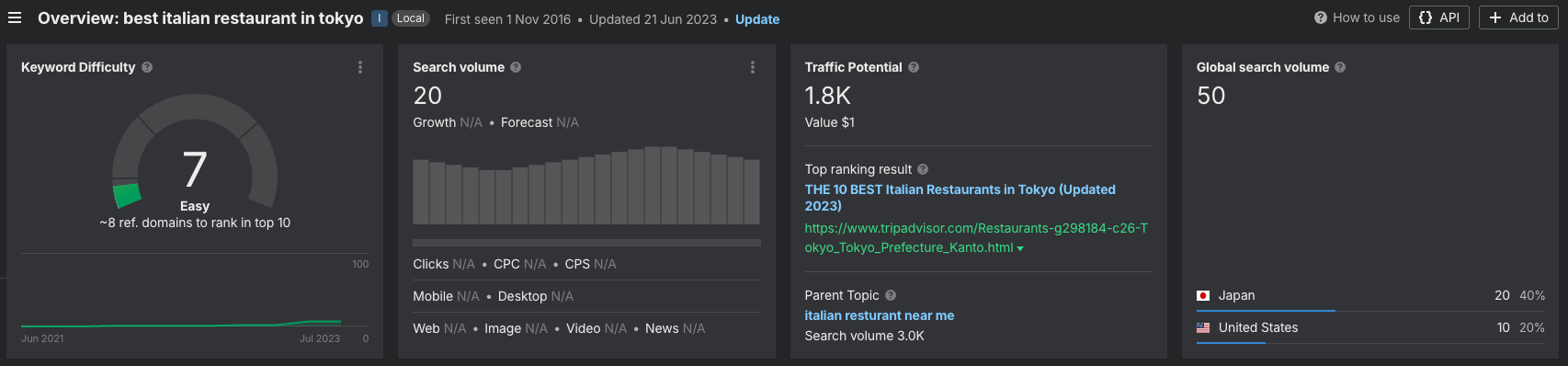
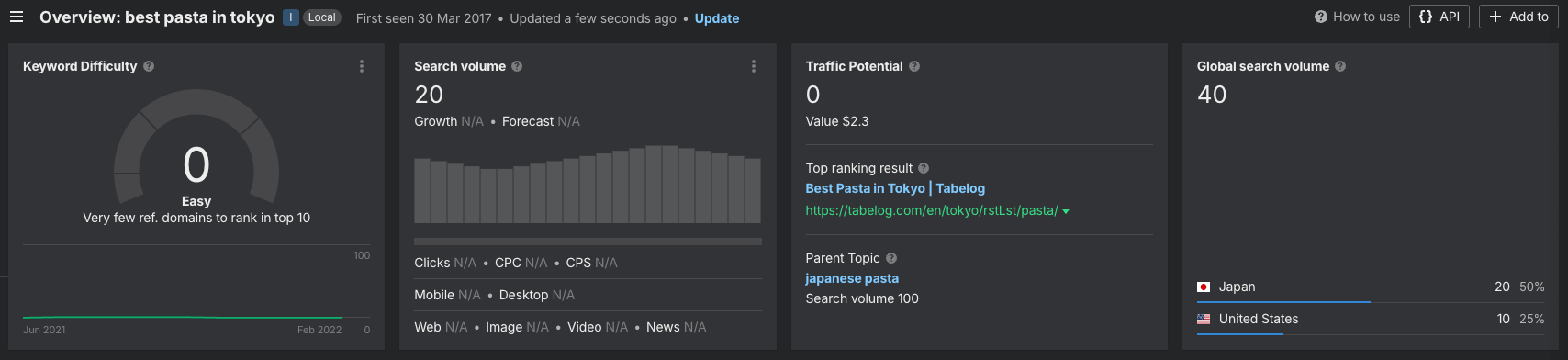
*Screenshots from Ahrefs showing the estimated search volume for the target KWs.
It wasn’t long till I’d created pages targeting these KWs fulfilling the intent Google was looking for. I then created reverse silos for the pages, utilising URLs that contained the few powerful backlinks that the expired domain had come with, to give me a headstart.
My estimation was that the site would take around a year before Google started to acknowledge it and reward me with some rankings - remember that I wasn’t paying for any additional backlinks at all and keeping to my initial idea of spending zero budget after purchasing the domain and hosting it.
Ranking above Leading Sites in the Niche within 1 month for “Best Pasta in Tokyo”
I’ve built a reputation of ranking company eCommerce sites I’ve worked at while in-house (all in difficult niches) in record time. But with a very low level expired domain going into a niche dominated by powerhouses such as TripAdvisor and huge online magazines, I didn’t expect to rank on the 1st page for my target KWs within 6 months.
To my surprise, by focusing on on-page SEO factors and leveraging the headstart in “trust” from the expired domain, I managed to rank for “Best Pasta in Tokyo” within 1 month of my SEO test.

*Above is a screenshot from Ahrefs showing my site’s ranking position over a year - as you can see, it remained very stable throughout my test.
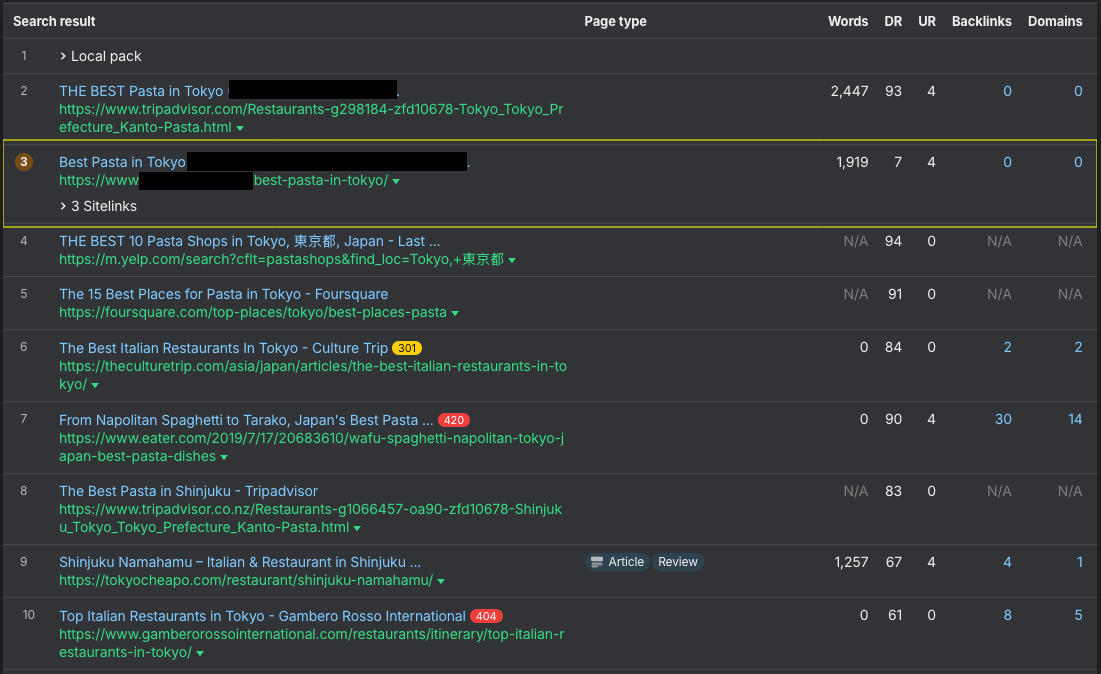
*Screenshot of Ahrefs’ SERPs for the same KW.
As you can see, when I say “low level expired domain”, it was considered a DR7. I was outranking Yelp and Foursquare with my blog, as well as some of the biggest travel & Food magazines in the niche including Eater.com, TheCultureTrip, both with DRs of 80-90.
At this point I was tempted to send some backlinks to this page to see if I could rank #1, but I really wanted to complete my test under the original conditions I had set.
So, I continued being patient and seeing just how far I could go with other KWs.
Ranking 1st page in both Japan & US Search Results for “Best Italian Restaurant in Tokyo”
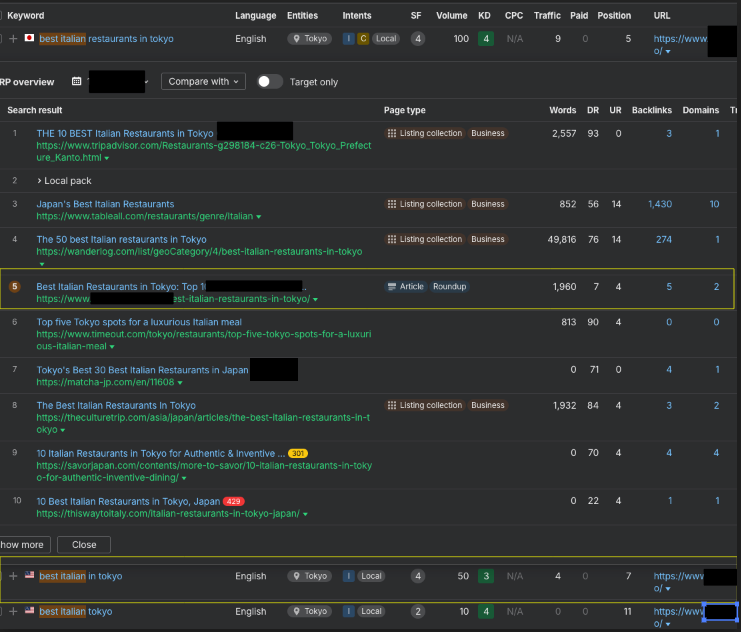
*Screenshot of Ahrefs showing my site ranking in #5 above the likes of TimeOut.com
It wasn’t long after until I saw other supporting pages and main pages fly up the rankings, with Google quickly establishing my website as an authority in Italian food related topics in Tokyo/Japan.
I started ranking for “Best Italian Restaurant in Tokyo” on the 1st page in Japan - as well as the US, 2 positions below the “Michelin Guide” website - which really put into perspective what I’d achieved at this time…spending extremely minimal time getting a site live and just leaving it to exist after ensuring on-page factors were on-point.
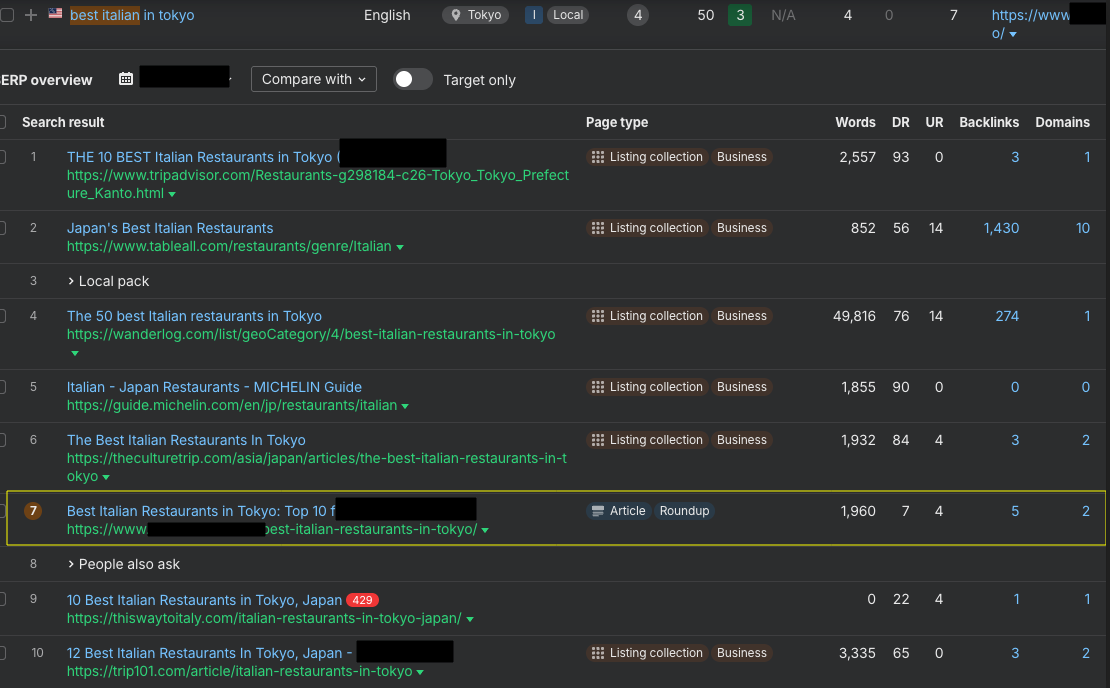
*Screenshot from Ahrefs confirming my #7 ranking position among the likes of the Michelin Guide website. I did naturally pick up 2 spam links to the page, which would have had no off-page impact.
Confirmation of Tourists mentioning they’d seen the restaurant recommended on a website online
Even when I ranked for the keywords I’d originally targeted in the US and Japan, I still didn’t want to heighten my expectations that I would actually send physical customers to a restaurant outside of Tokyo.
After all, while I did rank, I did so for KWs with search volume for as close to the restaurant as I could, but weren’t perfect; the KWs targeted “Tokyo”, while the restaurant was located around an hour train ride away from Tokyo.
However, a few years after the site continued to rank and remain stable for KWs, I received verbal confirmation that the restaurant had received tourist visitors mentioning that they found them through a website recommending them on Google.
Conclusion: You can still beat some of the top websites in each niche with better on-page and Technical SEO.
*Image Source: https://www.pexels.com/photo/google-search-engine-on-screen-13628541/
This test confirms what experienced SEOs and affiliate marketers have long understood: organic traffic generated from high-intent keywords is one of the most dependable drivers of revenue. Ranking for BOFU (bottom of the funnel) KWs in competitive niches consistently results in sales when the product and page experience are strong enough to convert.
One of the more significant outcomes of this test is the speed at which topical authority can be established. With focused keyword targeting and solid on-page SEO fundamentals, it is possible to position a site as a credible expert within a defined niche and rank alongside established, high-authority domains in a relatively short period of time.
As you’ve seen in the screenshots I’ve included, my domain was only a DR7 - hardly a “world beating” expired domain. In reality, the only “boost” it gave me was being almost immediately indexed instead of (sometimes) a fresh domain having to spend some time in the dreaded “sandbox”.
Overall, the results demonstrate that strategic intent targeting, strong on-page execution, and conversion-focused content can outperform brand size and domain age. When executed correctly, this approach turns existing search demand into measurable commercial results with efficient use of resources.