Unscripted SEO Podcast: How to Localise SEO and Digital PR for Every Market


Laura Smith, Head of Client Strategy, ICS-digital · Host: Jeremy Rivera · Unscripted SEO Podcast
In this conversation
If you run an SEO agency, the day a client calls from another country is the day this conversation pays off. Here's what we talked about.
- Translating a campaign is not localising it. A plan built for one market can fail in the next for reasons as mechanical as word length: German words are too long for a Twitter character limit.
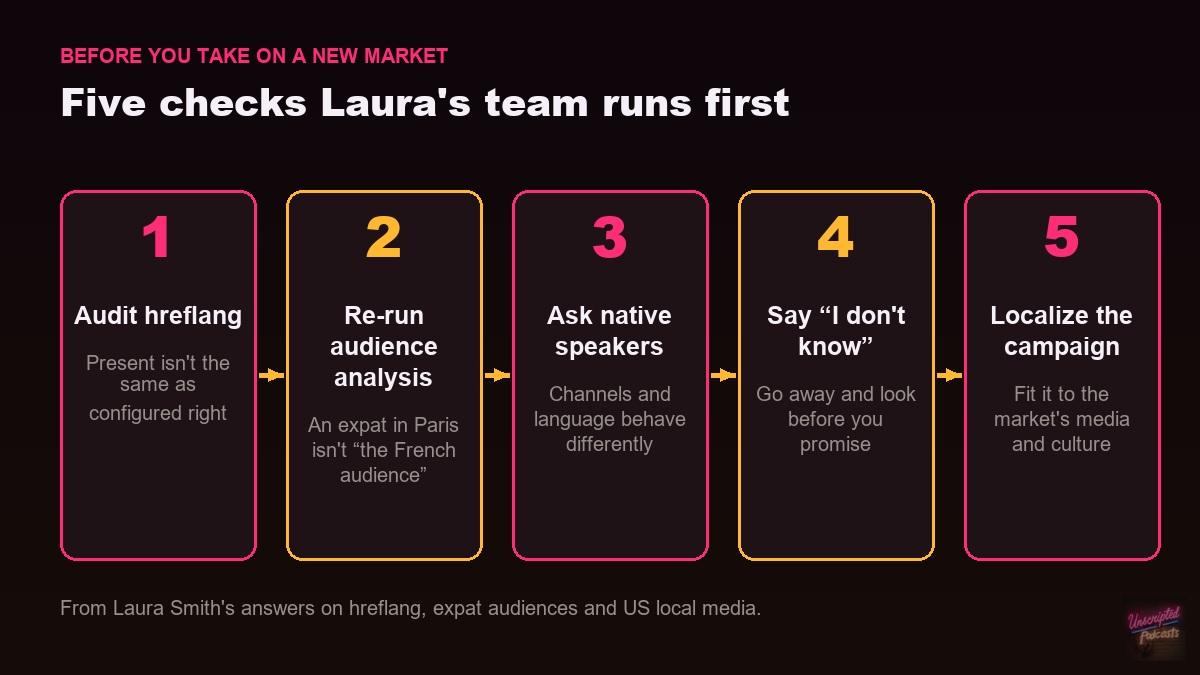
- Check hreflang first. It's the technical issue Laura's team keeps finding in audits, often present on the site but not configured quite right.
- Start every market from scratch. A UK expat living in Paris is not “the French audience,” so go back to audience analysis for this brief, this month.
- Say “I don't know” out loud. The biggest pitfall is assuming what worked before will work here; US state and local media need truly local stories that UK city splits don't give them.
- Authenticity is a practice. Laura started a TikTok to get comfortable hearing her own voice, and stopped running her LinkedIn drafts through AI once she had the reps.
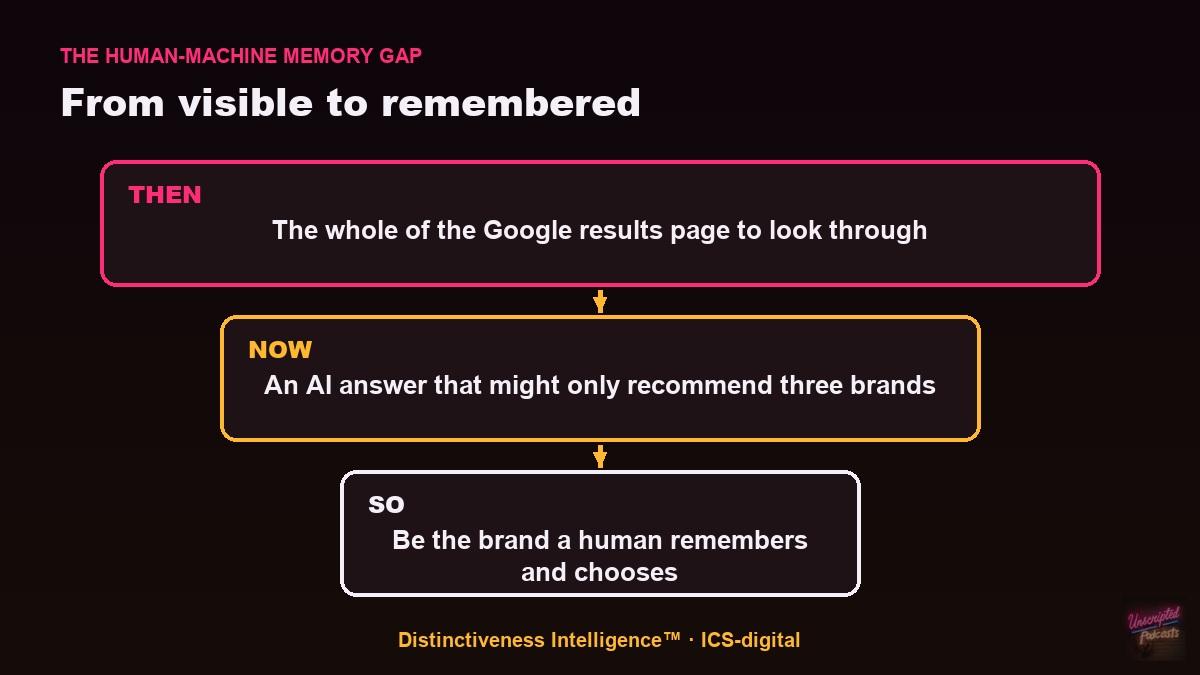
- Being visible in AI isn't enough when an AI might only name three brands. ICS-digital's white paper and its Distinctiveness Intelligence framework are about being the brand a human remembers.
Jeremy Rivera 0:00
Hello, I'm Jeremy Rivera, your Unscripted SEO podcast host.
I'm joined today by Laura Smith of ICS-digital, specialising in international SEO and marketing.
I'm very excited.
Anytime that I get somebody with expertise overseas, I find it fascinating.
So we're going to jump right in with a solid question: why should I trust you as an international marketing expert, Laura?
Laura Smith 0:32
So it's a good, strong first question.
But I guess in terms of my experience in international, ICS is working in over 100 languages across both digital and translation.
So we do both sides of that.
And my experience leading that team from a strategy perspective encompasses our SEO, digital PR, paid media, creative, and then also bringing in that translation element as well from an international perspective.
And I have been working in marketing generally for over 15 years at this point.
Not always in international, to be honest about that, but hopefully I can bring some good knowledge on the international side.
Translating a campaign versus localising it
Jeremy Rivera 1:17
What is the most surprising positive from working in international marketing?
Laura Smith 1:28
When I first moved to ICS, I had dabbled, I guess, a bit in some international.
I’d done bits with clients across, say, France, Germany, some of the European markets.
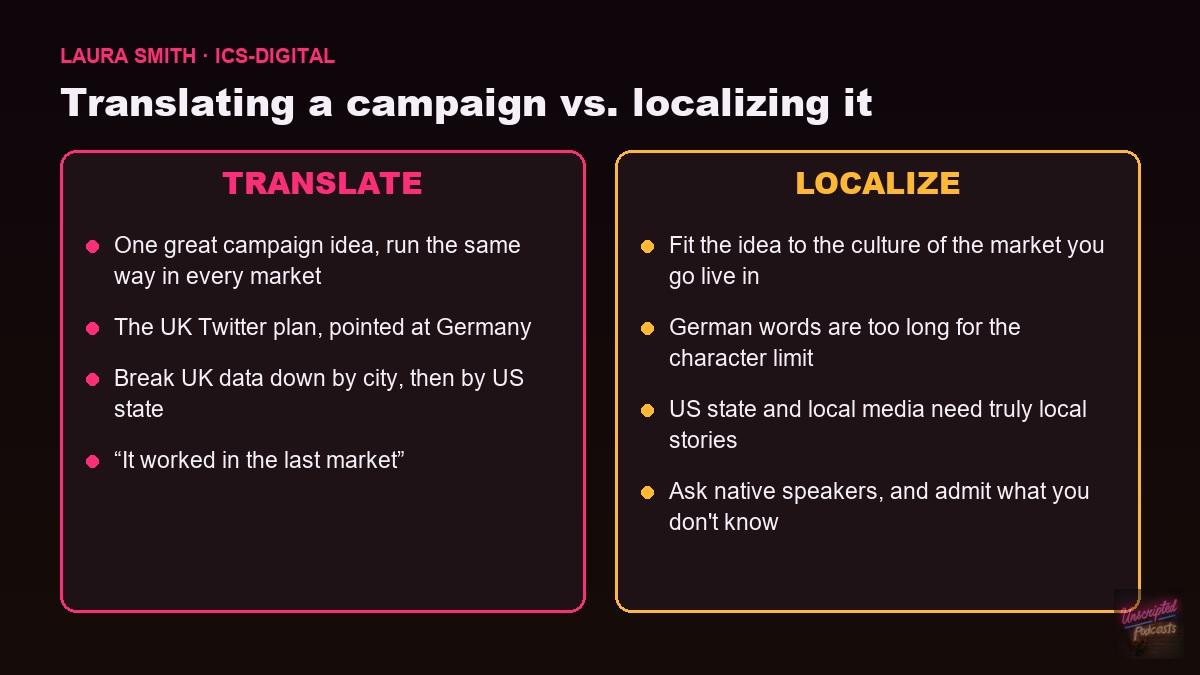
But moving to ICS, I feel like I really learned about the importance of not just translating a campaign, but localising it.
So a lot of agencies might, and I'm not saying this is the wrong thing to do, go after just coming up with a great campaign idea and just executing it in exactly the same way in every single market.
But I feel like the actual exciting bit of the campaign comes from localising it to the culture of the market that you're going live in.
“I feel like the actual exciting bit of the campaign comes from localising it to the culture of the market that you're going live in.”
— Laura Smith, ICS-digital
Because something that lands in the UK doesn't necessarily land in the same way in the US or in Europe or across Asia, wherever you're outreaching or wherever you're engaging with your audience.
Jeremy Rivera 2:29
Can you think of a concrete or specific example to really drive home that difference?
Generally, I would agree that sounds like it's good in practice, but if you have a case study or a cherry-picked anecdote, that'd be clutch.
Laura Smith 2:46
Yeah, for sure.
I personally was working on a German campaign, and I was all in on going all in on Twitter and using what we were doing in the UK, which was very much Twitter at that point, and working out how we could bring the campaign to life across the Twitter platform.
But then actually, when we were talking to experts in that market, they were like, well, Germans don't use Twitter in the same way.
The words are literally too long.
It doesn't work within that character limit.
So you cannot use the platform in the same way that you can in the UK.
And that's obviously a few years ago now, because it was Twitter, but that's the kind of thing where you just may not think about it if you don't know the languages.
I may work at an international agency, but I'm not fluent in other languages.
So I do really need to speak to native speakers, people who actually know the language inside out and know the nuances for where work can land from a digital perspective.
Reporting across markets and fractured teams
Jeremy Rivera 3:53
Is there a set of practices that you use on the analytics side to try to parse and understand these digital marketing campaigns and their impact within the specific market?
Particularly within the fractured nature of GA, GSC, Clarity or other analytics packages, trying to map and understand the campaign from an analytics standpoint.
Laura Smith 4:26
Yeah, it's not necessarily what I'm doing on a day-to-day basis, but we do follow quite strict reporting frameworks that can be laid out across different markets.
But it is definitely a challenge that our clients face, if we're setting the strategy centrally and then going out with different campaigns on a local basis, making sure that we're reporting in the right way.
I guess the other challenge, actually above the tools, is that the teams can be quite fractured as well.
Depending on the size of the business, you might have teams that aren't talking to each other all the time that are looking after different markets.
So we can end up being the go-between, trying to bring things all together and make it make sense to everyone, and making sure that each individual person gets to see what's relevant to them and is actually needed.
So that's another challenge – it’s not just that the analytics are tricky anyway when you're working with a big international site.
I think sticking to really focused reporting frameworks tends to be our guiding light: what's the overall goal, and what are the indicative metrics that can help us know if we're hitting that overall goal?
And then how does that need to change dependent on the market, depending on the exact work that we're doing.
Getting ahead of enterprise red tape
Jeremy Rivera 5:55
You definitely strike something on that red tape aspect.
If you have an entity that's large enough to be viable in multiple markets across countries, then you're looking at a business that also has multiple physical offices, multiple marketing teams, multiple competing goals.
And we always say you have to look at a campaign through the lens of revenue.
Well, that revenue's coming in in Euros and in dollars and whatever different currencies you might be looking at.
So that raises an aspect.
Is there any best practice that you've developed to handle the extra layer of red tape that might come with working with that type of enterprise?
Laura Smith 6:46
Yeah, wow.
It can be very tricky and complex, like you say.
I think for us, it comes in at the kickoff, the setup, making sure that we get everything in place as early as possible, to make sure that we understand where that red tape might be and that we have things mitigated as best we can as early as possible.
When you're working with a company that maybe has offices across multiple continents, and then you have the different digital teams in each of those markets and they all have different priorities, there may be someone centrally who's brought us in to help them across the board.
It does get difficult to make sure that communication is really consistent and we're all working towards those goals.
I think getting ahead of that is normally where we try and make sure, especially in that month one, but realistically, if it's a longer-term piece of work, over the first one to six months, we're really having those conversations as early as possible.
Tracking to see if what we're doing is working, people missing information, are we not getting the right data into the right places, is there anything that we can tweak to help their internal teams.
I guess the other thing with a business like that is that they very often have very skilled and very capable internal teams as well.
So it isn't that we've come in because there's no one internally who can do the work, it's that we've come in to support on specific aspects or just help to make sure that the strategy is really consistent.
So being able to work with those experts can really help you get around red tape, or at least try and mitigate it as much as possible.
Expat audiences and starting from scratch
Jeremy Rivera 8:32
I'm curious if your team has tackled expat populations within a particular country.
Like if you're trying to speak to English folk who are living abroad in Spain, in Ibiza, or trying to reach a Spanish-speaking population in the United States, that type of scenario.
Have you come across that, and any insights there?
Laura Smith 9:03
Yeah, it's definitely something that we have come across.
It probably isn't the only thing, a lot of our clients aren't just focused on that, but I think that probably comes back to, I guess, audience understanding.
We use GWI as our audience analysis tool.
So I guess making sure that we really dig into what that audience is like, what channels they’re using, because obviously different markets will use social media differently, or use different platforms, or react differently to advertising.
You might get blanket insights on, I don't know, for example maybe a French audience is a bit more hesitant to believe just a paid advert, and you need to do more work to get them onside.
That might be the case, but actually if you're then targeting people from the UK who are living in Paris, for example, blanket how you market to France isn't relevant anymore.
So I think going back to basics in terms of that audience analysis helps us to uncover, actually, if we're looking for people who are UK but living in France, they are actually still using XYZ in these ways.
And I guess not being afraid to start from scratch.
For us, we work in a lot of different markets, work with a lot of different brands, but we always like going back to the start of being like, actually, what do we need to find out here that's relevant to this brief in this specific month?
Because things change in our industry all the time, don't they?
So what do we need to know right now, and then using that data to guide where we need to go.
AI search when every market moves at a different speed
Jeremy Rivera 10:44
I'm curious on the perspective, as an early adopter of AI technology myself, using LLM-based models in Jarvis in 2015.
But obviously everybody became more aware of it in 2023.
I know that there are some countries where they haven't even had AI Overviews roll out and impact their SERPs, and other countries don't have access to ChatGPT.
Others have more saturation in certain situations.
Ukraine is very AI-forward, as I understand it.
So what's been your experience working with folks grappling with the changes in marketing coming from LLM tools, both on the utilisation side within organisations, and as a new distribution channel, a new medium for people to interact with your brand?
Laura Smith 11:47
Yeah, no, I think from my perspective, and I think from my agency's perspective, we always want to make sure that we're not just going after the next hacky thing that might work.
So I think that does set us up for success when we are working in multiple markets.
We're not just like, doing this exact thing will mean that we appear in the AI Overview, or doing this specific thing will mean that we appear in ChatGPT.
We try and look at it a bit more holistically.
So it does become relevant, say, if usage is different, or maybe ChatGPT isn't in certain markets, but you can still take what we know about how modern search works and apply it internationally across different markets.
I think that's how we, I guess, always try and make sure that we're setting strategies and solutions that are built for the longer term.
Obviously there are quick wins all the time, but not just, we'll just get us ranking here, we'll just get us visible here, and really make sure that we're taking those learnings into different markets.
I think the AI Overview one is really interesting in terms of making sure that you're not falling into the trap of creating content that's just going to get you into the AI Overview, or leaning too far into, I don't know, chunking things in a way that isn't right for a person to actually read it.
Thinking about how you're actually writing content, and making sure it is thinking about not just appearing, but also the human reading it.
And that's very important when you're writing in different languages and you need to make sure that your brand is coming across in that consistent way, across multiple markets, across multiple languages as well.
The international pitfalls: hreflang and "I've done this before"
Jeremy Rivera 13:40
What do you think about pitfalls that SEOs don't know about when they suddenly get somebody calling from Canada and you're based in the US, or you get a referral to somebody based in another country?
What's the most common pitfall they're going to step in when it comes to SEO or the technical SEO aspect?
Laura Smith 14:12
Yeah, I guess the one that comes up a lot in our conversations is the use of hreflang from a technical perspective.
Even if it is on a site, our tech team will be like, maybe it isn't configured quite right for the best possible outcome.
Or people have tried to do it, but maybe aren't thinking about all the different aspects.
I don't claim to be a technical SEO, but that's something that comes up in a lot of conversations and a lot of audits.
I think from a general planning-your-strategy perspective, and planning your campaigns or content or whatever that looks like, it can just be so easy to fall back to, well, this has worked in a market that I've worked in before, so surely it will work in this market, and not doing the work to actually look at what is working in this market right now.
So a really, really obvious one for digital PR, which is what I did for a long time, is the US.
It's a completely different media landscape to what we have in the UK, in terms of specific state media, local media needing really localised stories.
Whilst we do have that in the UK, it's obviously a lot smaller, and our stories will be really relevant if you just make it that you can break down data, for example, by different cities; they'll potentially be interested in it.
Whereas you can't just take a campaign and just break it down by state and just expect all of the state media and local media to think that's interesting.
It just doesn't work in the same way.
So I think the biggest pitfall is thinking, I've done this before, so I'll just do it the way I've always done it, and not digging into the market, or even just being open that you don't know.
“I think the biggest pitfall is thinking, I've done this before, so I'll just do it the way I've always done it, and not digging into the market.”
— Laura Smith, ICS-digital
Sometimes I just have to be like, I don't actually know.
I've not done a digital PR campaign in that market, or we've not done this exact thing in that market.
We're going to have to go away and have a little look into it.
That's something that we have to say sometimes: yeah, we think it's possible, but can we just go away and look into this in a lot more detail for you, so we feel really confident, and not just thinking we know because we've done these types of campaigns before.
Because you just don't know every market.
And I think you have to be very honest with yourself when you don't know if you're trying to make things work internationally.
The cobbler's children, and a press release deleted in full
Jeremy Rivera 16:42
They often say that the cobbler's children have no shoes.
As an agency, you have to have a different type of footwear, is what you're basically saying, for every market and niche.
How are your clogs? Do they fit?
Laura Smith 17:02
I think we are working on making them fit.
I think every agency struggles with it, or it wouldn't be a question you'd ask, but I think we are working towards better solution-based approaches to help solve client problems, whether that is specific to niches or whatever that looks like, and, like I said before, thinking about longer-term plays that set you up for success in the future.
But agency marketing can be last on the list when clients are calling, can't it?
Jeremy Rivera 17:41
Absolutely.
I'm curious, what's one of your favourite stories from your experiences with your clients?
Laura Smith 17:52
As in a client experience I've had, a story?
That is a good question.
I feel like this sounds bad.
This sounds like a traumatic story, but now I look back and I'm like, God, these things make you better overall, don't they?
I had a client, this was maybe 11 years ago at this point, quite a long time ago.
By the end of the relationship, we had such a good relationship, but this was quite early on, and he didn't know me.
I'd written a press release, I think I was an account manager at the time, and I sent it to him, and he was a fantastic marketing director.
He'd worked at a lot of high-profile places.
He'd just come into the business that we were working with, and he sent back the press release with tracked changes on it, but just deleted the whole thing and told me to rewrite it.
Which sounds really harsh when I say it out loud, but stuff like that teaches you how to deal with clients.
And I'm not saying that that's how I would expect a client to act now, but it did mean that we got to a better piece of work at the end of it.
It was maybe not the best communication, but it did mean that the work was better.
And I think that was an early-on experience for me, of, it's not always going to be smooth sailing with clients.
Sometimes they're not going to agree with what I've done.
Sometimes I think what I've done isn't good, and that's okay, because I can just continue to get better and continue to improve.
There's hopefully lots of positive stories from where I've been able to do great work for clients, but I think that one sticks with me as something that taught me something about how to be better at managing clients, and to understand that working with clients isn't always smooth sailing.
But I'd still do it now, so I must like it a lot.
Meme culture, and whether brands should touch it
Jeremy Rivera 19:49
I'm curious.
I'm a single-country guy.
I love speaking in foreign languages, learning them, but it does seem hard to get into some of that understanding.
My question is this: is meme culture an American thing or a global phenomenon?
Laura Smith 20:14
I think meme culture is definitely not just a US culture thing.
I wouldn't necessarily say it 100% translates to every single market in the exact same way, but I would say that from experience, meme culture exists everywhere, which is great as a self-confessed chronically online person.
Meme culture definitely exists everywhere in a unique way.
I feel like sometimes you'll see things and you're like, I had no idea that this existed, and this just doesn't make sense to me, but I think that's part of the fun of it.
Jeremy Rivera 21:00
Is it cringe, or something that you'd want to try to get your client to go down, a meme-related concept?
Laura Smith 21:17
My first reaction is that it's cringe.
And I feel like I need to unpick whether that is actually true.
You asked it and I was like, absolutely not, that is the cringiest thing you could do.
But I do think some brands can do it.
But I think you have to have such an intrinsic, detailed understanding of the culture that you're operating in.
And I think too many brands don't understand the culture, and their brand's culture, and how their brand fits into culture.
And then if you are just, I don't know, seeing a TikTok trend once it's already got millions and millions and millions of views and then just being like, we need to hop onto that and just do it, like, no.
Jeremy Rivera 21:59
So don't chase the trend, but maybe if you've got the talent, go for it, right?
Laura Smith 22:12
Yeah, yeah, I think you can do it, but I think a brand has to be willing to admit, if they go down the road of actually creating something, to them saying, this was cringe and we shouldn't have done it, and then never posting it.
Give something a go.
Authenticity at scale: it's a practice thing
Jeremy Rivera 22:33
But you're right, there has to be a brand entity awareness, which comes to an authenticity aspect, which I've mentioned a couple of times.
How do you deal with the intrinsic nature of the falsity of marketing versus the desire of the marketplace for authenticity?
Because you have people acting within an organisation, and at the scale that has multiple markets, you have to have an animus that spreads across multiple teams.
So how can you authentically market when you have so many people that you have to onboard to a core content?
There's a bit of play-acting that goes with that.
How do you square those two conceits?
Laura Smith 23:30
Yeah, gosh, it's really difficult.
And I think we're not even that big of an agency, and it can feel difficult.
I think for a long time I was like, I need to do more on LinkedIn, I need to do this, but it doesn't fit.
It feels false.
I feel like I'm faking it.
I'm faking it to make it, you know what I mean?
It felt like that.
And I think you do have to get people around, like you say, that central idea of what you want to be and how you want to show up.
But I guess also support people to find their own voice.
I think that's something that I've probably struggled with in the past.
I've never wanted to really listen to podcasts that I've done, or if I've done a video I've been like, God, I can't listen to that, it's awful.
But then I was like, hang on, I should be able to be proud of what I'm saying and talking.
I started a TikTok this year to essentially teach myself to listen to what I have to say and not feel embarrassed by that.
And that, I think, helps you to show up authentically.
I feel like actually practising it helps you to be more authentic.
Even though that feels a bit counterintuitive, to say practising something means that you feel more authentic.
I feel like I went through a stage where I relied on AI to help me draft LinkedIn posts, or I'd draft something and I'd put it through AI and see how it would improve it.
And now I just post it, because I'm just like, well, I think I know how to write, or at least I know how to write in my voice.
But I think I needed the reps to get to that point.
So I think if you are working with a big team, and even if not all of that team are willing to do it, but you have maybe a core group that want to show up but maybe aren't sure, it really is a practice thing.
You just have to keep doing it until you get more comfortable.
And I guess it's about encouraging that it's okay if you fail.
It's okay if you post something on LinkedIn and it gets no impressions and one like, it's totally fine.
Because if you just keep going, you will get more comfortable with being yourself, and that will breed the authenticity.
But if you're all starting from nothing, it can feel really daunting.
A first podcast, before day one
Jeremy Rivera 26:08
I'm curious, you said you've done a couple of podcasts, and I think you said your brand had started its own podcast.
Are there any conversations that you've had, either with guests or as a guest with the host, that stick out in your memory?
Laura Smith 26:29
Yeah, my first ever podcast was actually for an ICS podcast.
And I hadn't actually joined the agency yet.
I was just waiting to join, in between leaving my last role and joining, and they invited me in to just chat about my experience and what I was joining as, a digital PR director.
So I was talking about digital PR, what I thought about the digital PR landscape, how it linked to SEO, all that sort of thing.
It was very informal, but it was actually the first one I'd ever done, and I was like, I have to do this, I have to make a good impression at this new agency that I'm joining, that they want me to be on this podcast.
And I think that was actually such a good way of doing a first podcast.
I guess that ties into what I was just saying about getting the reps in and the practice stuff: if you can do just a friendly conversation with someone that you know.
This was with, now, our head of market growth, who I work with really, really closely.
I didn't know him then, but I think he'd maybe hosted one before as well.
So we were just making it work between us, just having a conversation.
And then that got it out of the way.
I've done a podcast now.
That podcast is live.
I've actually done that.
I can do another one.
I can feel confident to do another one.
So I guess that sticks out as a good, positive first experience of doing this type of thing.
Digital PR's moment in SEO
Jeremy Rivera 28:07
As a digital PR person, seeing SEOs struggle and realise, hey, maybe I should have been talking to digital PR a little bit more, do you feel a little bit of na-na-na-boo-boo?
Or are you magnanimous about this moment where digital PR is getting more of a shot from the SEO people?
I admit I've ignored that aspect, or been locked out of it, or it's just been happening somewhere else, and by the way we released a press release, and by the way we got this.
Maybe I got siloed out, and maybe I never really tried that hard to connect, but it seems like a moment.
What are your thoughts there?
Laura Smith 28:56
Yeah, I think I started doing digital PR in 2017, and it was very much like the SEOs are here, we're here, and we have maybe a weekly meeting, even in an agency that was really leading the way from a content marketing perspective.
So I guess now it is indicating that what we do, and what I did for years, is really valid and useful.
I think for me the more interesting bit is, I think there's always been SEOs who celebrated the idea of getting these high-authority backlinks.
They understood the value in that even if they didn't quite understand PR, and they've always been the champions of digital PR.
I think the really interesting bit now is the link to brand.
I started in more traditional PR, doing a lot of B2B, a lot of press office, or little restaurant launches and things like that.
That was my introduction to the industry.
I didn't know what a link was until 2017.
I literally remember the head of SEO having to explain to me why a link was important.
We just didn't know, from what I'd been doing.
And I think now there's the understanding that actually digital PR plays such a big part in impacting your brand.
And I guess the rise of AI search is a huge part of that: the brand entity, and how digital PR and third-party publications and citations, brand mentions, all of it plays a part.
I think that's the bit where I'm like, I hope the SEO community can see how valuable all of that is.
And if they are starting to see that, then that's brilliant, because there's a lot of very, very talented people working in digital PR who I think can have a really big impact.
I mean that across many agencies, across the UK, across the US.
There's so many talented people who've been screaming from the rooftops about how important digital PR is to brands, so it's great that it's finally been taken, I guess, a bit more seriously.
The Human-Machine Memory Gap
Jeremy Rivera 31:08
As we wrap up, are there any releases or data or blog posts or content or podcast episodes that you've released recently that you would point somebody to, to both see what you guys have been working on and maybe learn something new?
Laura Smith 31:26
Yeah, so I guess the big release for us this year has been launching our white paper, which I guess I authored, really.
Jeremy Rivera 31:38
I accidentally authored something. I didn't know I was sleepwalking and I accidentally made a white paper.
Laura Smith 31:44
It was a real team effort to get it over the line, so it's not really just my work.
That's called The Human-Machine Memory Gap, and it looks at our views on AI search and what it means to be remembered by people, and why it isn't just about being visible in AI.
You need to understand why a human is going to choose your brand, which is especially important when an AI might only recommend three brands, compared to previously having the whole of the Google search to look through.
“You need to understand why a human is going to choose your brand, which is especially important when an AI might only recommend three brands.”
— Laura Smith, ICS-digital
So we released this white paper earlier this year and launched our proprietary framework, Distinctiveness Intelligence, which I guess is my baby, for how we approach search in 2026 and hopefully beyond.
I'd say that hopefully people would find that white paper interesting.
We look at the behavioural science side from a human perspective.
We look at what's impacting AI.
We look at some examples, sectors for how that might show up with specific brands.
And then, I guess, how we want to approach it through different services, different layers, to bring your strategy together.
Jeremy Rivera 33:05
Thank you, everybody, for listening.
This will be available on YouTube, all of the channels, like and subscribe, et cetera.
I've never actually said that on a video before, but I understand that you have to.
It's a weird thing, you have to ask people to like and subscribe to your stuff.
It's always felt awkward to me, but I guess I just have to, right?
Laura Smith 33:47
Yeah, I think you do have to, but it never stops feeling awkward.
Jeremy Rivera 33:52
All right, that's the lesson for me and everybody else.
Just do it.
It feels a little awkward, but you've got to do it.
Thank you so much for joining me, Laura.
Laura Smith 34:00
Thanks so much for having me.
Similar Posts