The Human-Machine Memory Gap in Action: Analysis of a Women’s Wellness Brand


In October 2026, I took to the stage at brightonSEO! My talk was titled: Developing a Distinctive E-commerce Brand: Using Contexts in AI Search. A huge thank you if you were there or have watched the recording! You can see my slides here.
In my talk, I used a real brand example to demonstrate the Human-Machine Memory Gap – a concept I’ll explain in more detail below. In this blog, I will build on that initial snapshot analysis with a consumer survey and a larger set of AI responses.
The brand I chose to analyse is Free Soul. I love this brand! I have been a customer for a long time – I use their protein powder in my breakfast smoothies, and am a loyal, repeat buyer.
With my strategy hat on, I also think the brand shows strong signs of building distinctiveness in the category – the packaging, the website and positioning all very clearly communicate “women’s wellness”. Alongside the work they’re doing across social media, this made me curious about how widely that distinctiveness extended – and what people and AI associated with the brand.
To confirm, neither I nor ICS-digital has a commercial relationship with Free Soul. They’re simply a brand I personally like and wanted to explore.
What is the Human-Machine Memory Gap?
I introduced the Human-Machine Memory Gap in the whitepaper of the same name earlier this year.
Essentially, the Gap emerges when people’s associations with a brand are different from how the brand is surfaced by machines – whether in the traditional SERP or by AI systems. So, a brand can be very well known by people, but have less AI visibility – or vice versa, not well known enough to be chosen by people when surfaced or recommended by AI.
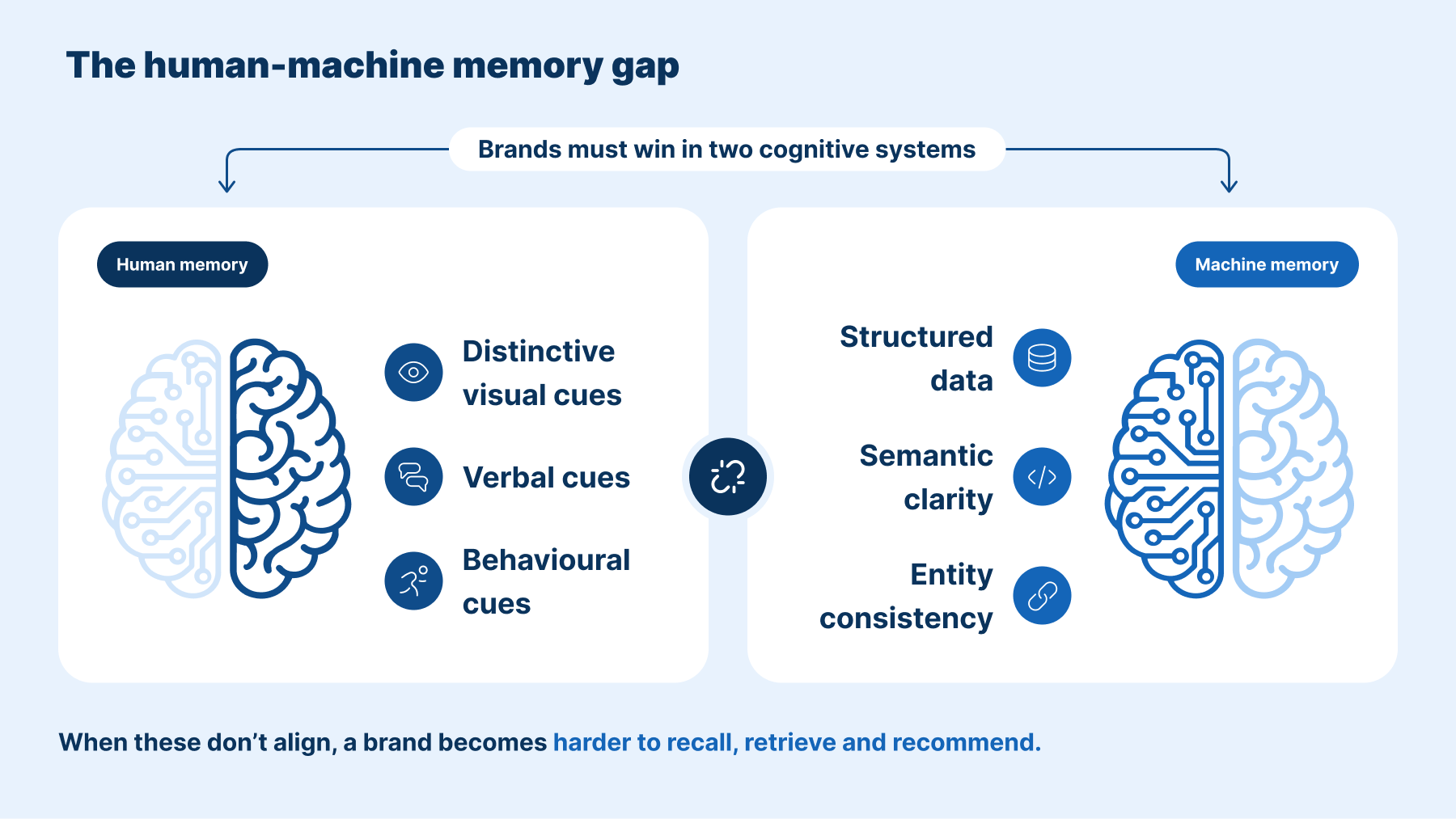
In AI-generated recommendations, brand choice can often be compressed to only a handful of options, rather than having reams of Google pages to scroll through. This magnifies the impact of the Gap! For example, if you’re presented with three brands after asking ChatGPT for recommendations, and you already recognise one, that familiarity may influence which brand you explore first.
The context someone is in when searching is a very important part of this impact – a person may associate a brand with a particular need, but AI doesn’t. They could therefore receive an answer that leaves out a brand they already know and might otherwise consider.
I talked more about mental, physical and retrieval availability in this recent blog, which discusses this challenge for e-commerce brands in more depth.
From an initial snapshot to a larger exploration
For my brightonSEO talk, I began with a manual snapshot of how Free Soul appeared across AI prompts about women’s nutrition, protein and wellness.
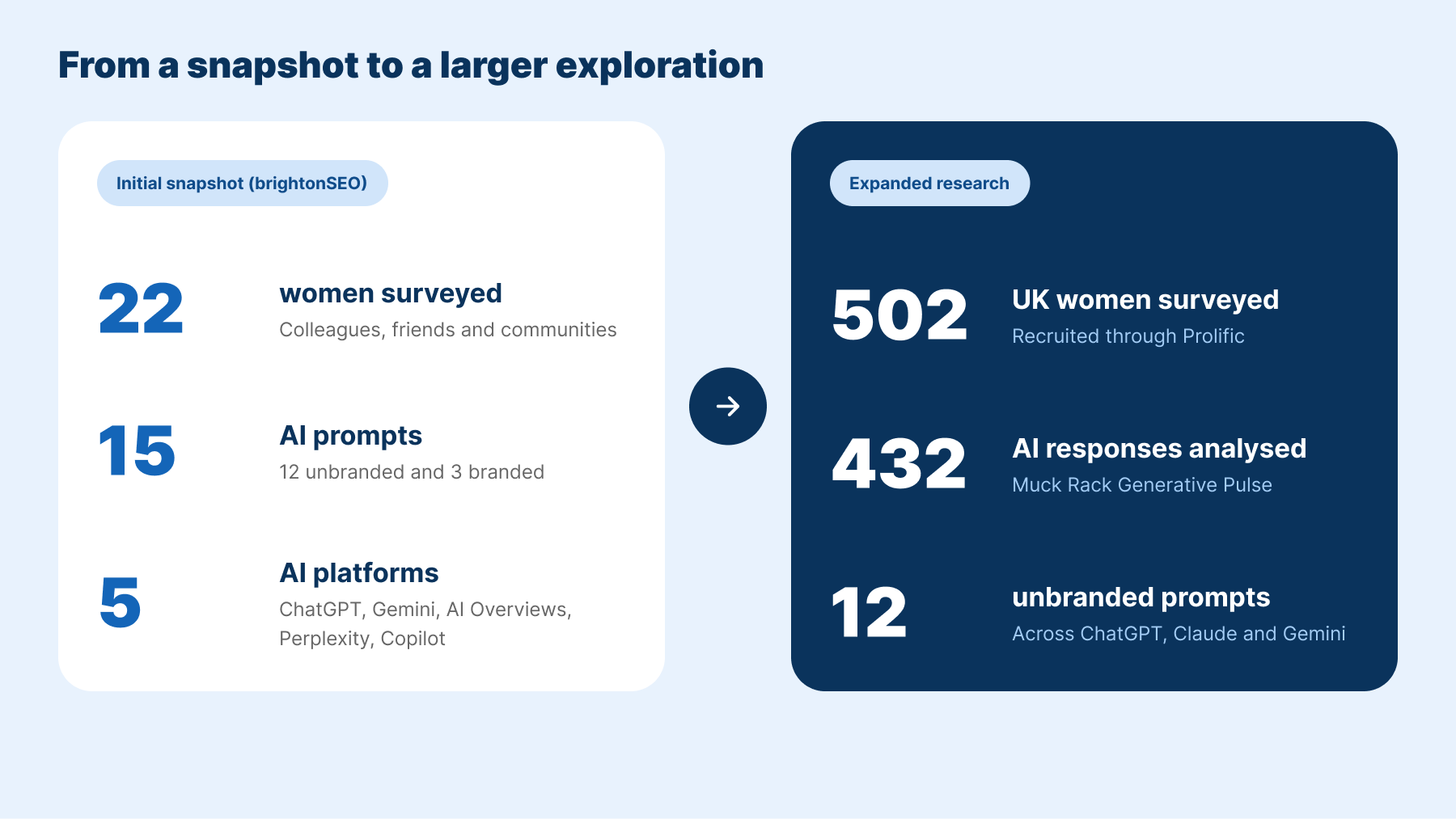
For the initial AI prompt snapshot, I tested 15 prompts – 12 unbranded questions and three branded questions – across ChatGPT, Gemini, Google AI Overviews, Perplexity and Microsoft Copilot, using a fresh chat or search for each and remaining logged out where possible. I recorded whether Free Soul appeared, how it was described, its position where answers included a list, and the competitors and sources shown.
Alongside the AI snapshot, I ran a small survey with 22 women (a mix of colleagues, friends and members of communities), exploring which brands came to mind for women’s nutrition and specific situations, such as starting strength training, as well as which brands they recognised when shown a list.
This snapshot demonstrated a Gap. Free Soul came to mind for some survey respondents in specific contexts, particularly “starting strength training”, but did not appear in AI responses to the related prompt. I felt this was a great demonstration for my talk, but it also made me want to expand the research further.

So, for this analysis, I’ve used two sources: a survey of 502 UK residents recruited through Prolific, and 432 AI responses collected through Muck Rack’s Generative Pulse Report across 12 unbranded prompts. The survey explored spontaneous brand recall, consideration in specific situations and prompted awareness, and the AI exercise examined whether Free Soul surfaced without its name appearing in the question.
I designed this as an exploratory exercise looking to identify patterns that other brands can learn from when considering broad category awareness and visibility, and associations with specific contexts. Let’s get into it!
What the research revealed
The consumer survey
Overall, Free Soul was recognised by a quarter (25%) of respondents when shown its name in a list with other brands – it was third behind Vitabiotics (64%) and Myprotein (58%) indicating a reasonable level of awareness amongst our sample. This awareness question was shown to participants at the end of the questionnaire, so the list didn’t inadvertently supply brand names for their earlier answers.
In the unprompted questions, Free Soul was named for women’s protein (8%), women’s nutrition/wellness (5%), considered for starting strength training (6%) and as a brand with clean, simple ingredients (5%).
For women’s protein specifically, Free Soul was the second most spontaneously recalled brand when asked about protein products marketed to women, named by 8% of respondents, only behind Myprotein (13%). Excluding explicit no-recall answers, Free Soul’s recall rose to 17%.

When asked which brands they would consider for strength training, Myprotein was the most frequently considered brand, named by 21% of respondents, compared with 6% for Free Soul. After excluding no-recall answers those percentages increase to 31% and 9% respectively.
These associations were less apparent in other contexts. Only 2% of respondents considered Free Soul for support during perimenopause or menopause, while 3% considered it for remaining active over 40 or supporting hormonal health. Within this sample, Free Soul came to mind more readily for women’s protein and starting strength training than for these life-stage and hormonal-health needs.
However, it’s important to note that whilst the percentages aren’t huge, Free Soul was recalled across these contexts by at least some of our respondents, and that leads us nicely to reviewing the AI prompt data and how Free Soul surfaced there.
The prompt analysis
The prompt analysis used 12 prompts, aiming to cover a variety of different use-cases for Free Soul - from broad women’s wellness and nutrition through to context-specific prompts around strength training, hormonal health and menopause support.
The analysis used MuckRack’s Generative Pulse and a total of 432 queries were reviewed – MuckRack runs these queries through Google Gemini, Anthropic Claude and OpenAI ChatGPT each day. Across all queries, Free Soul was mentioned in responses 41 times (9.5%).
In the consumer survey, we found that Free Soul was the second most named brand for protein products, and that association is well reflected in the AI analysis - 93% of Free Soul’s mentions in this study were for protein-related prompts.
However, Free Soul had no visibility in this analysis across many of the other categories of prompts including starting strength training, women’s hormonal health and menopause and active and age-specific nutrition, despite some of our survey respondents associating Free Soul with those contexts.
This is the Human-Machine Memory Gap.
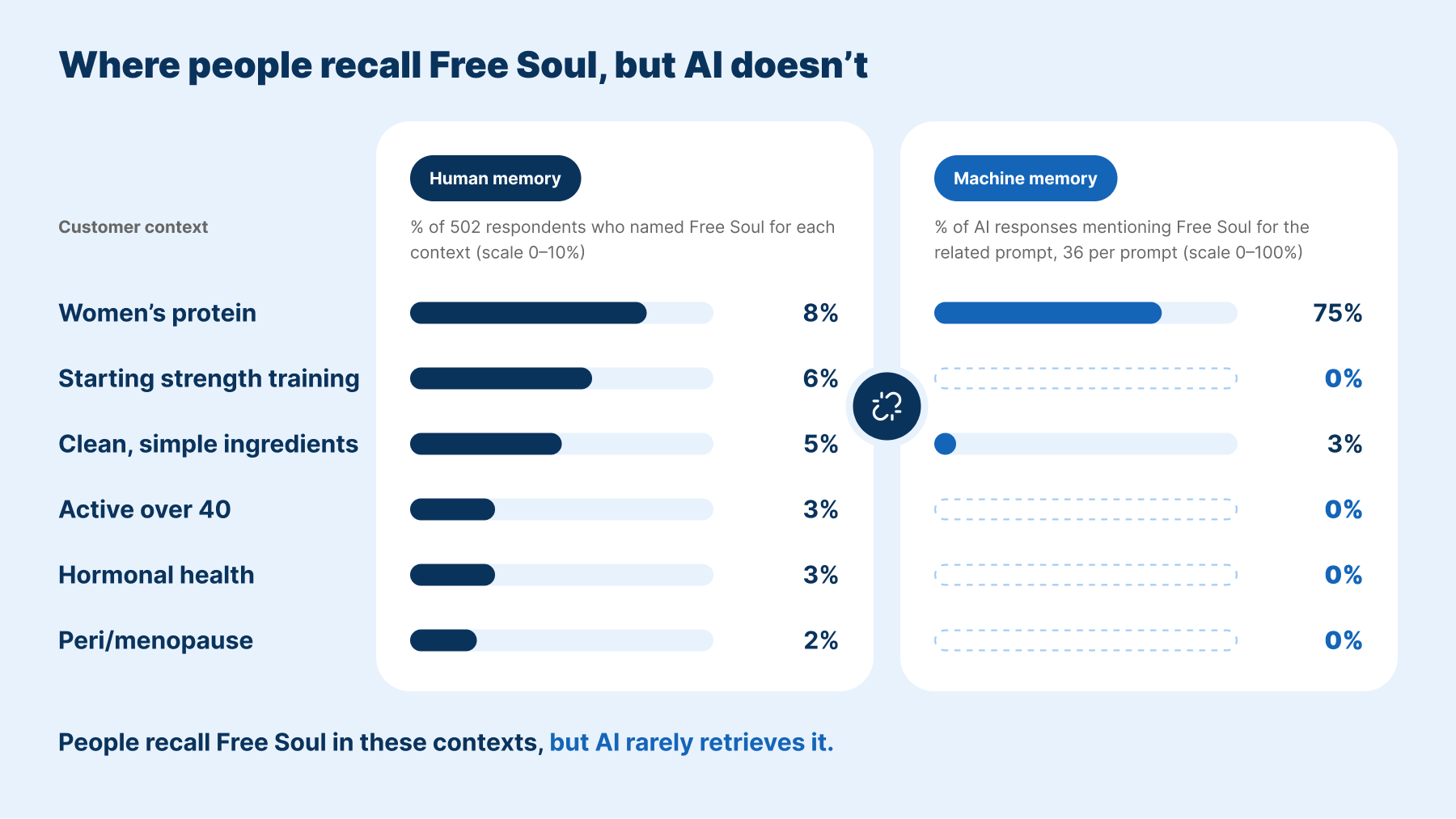
If any of the women from our survey who named Free Soul as a brand they would consider when looking to start strength training had gone to AI to ask “what is the best protein powder for women starting strength training?” they wouldn’t have been presented with Free Soul as an answer, based on this analysis.
So despite all the hard work Free Soul has put into building memory structures in people through its digital marketing (which even made me a customer!), it is not reflected in its AI visibility for context-based queries. And this is the biggest challenge facing brands in this new era of AI search.
The same trend can be seen for hormonal health. A relatively small number of women named Free Soul – 14 respondents, or 3%. However, if those 14 women asked AI “which supplement brands focus on women's hormonal health?”, they would not have been shown Free Soul, when realistically, they could have been on track to convert, or at least explore Free Soul more for that need.
My take on this analysis is simple: many brands could be impacted by this in the same way Free Soul is. Misalignment between how people remember you and your search visibility has never been more of a problem, and brands need to seize the opportunity to start ensuring their brand is associated clearly with target contexts across every communications channel.
How to explore this for your own brand
Inspired by this research, and want to understand if your brand could be being impacted by the Human-Machine Memory Gap?
First, you need to identify your customer contexts. Luckily, I talked about this in my brightonSEO talk, so please do take a look at the slides. You can use AI to support this process but always validate with actual brand data!
From there, you can design your own prompt study – if you don’t have access to a tool, the manual analysis I did took a few hours, and it did give me a usable directional snapshot. I personally drafted initial prompts and used ChatGPT to refine the list, redraft prompts and suggest additions. When running the prompts, I used incognito windows, used a fresh chat for each prompt and stayed logged out wherever possible. For platforms that don’t allow this, I set up a brand new user so there was no history or memory in the account.
Consumer surveys can be done for relatively low cost. If you have no budget, make use of Facebook groups or subreddits you’re a member of. You can also use AI to help draft the questionnaire for ease and speed.
If you do choose to run a similar piece of work, look for recurring patterns across multiple responses rather than treating one answer as definitive. A small survey drawn from your own communities will give you a snapshot of those respondents, rather than a nationally representative picture. Where people and AI differ, it’s worth investigating further and reviewing your existing content and broader marketing plans focused on that context.
This type of research is something we can undertake at ICS too, so please do contact us if you’d like to discuss.
Building a distinctiveness system to combat the Human-Machine Memory Gap
Our answer to the challenge created by the Human-Machine Memory Gap is Distinctiveness Intelligence® (DI), a data-led and performance powered framework that strengthens familiarity, enhances AI discovery and amplifies digital distinctiveness.
One of the first stages of the DI framework is Memory and Context Mapping – by establishing which contexts you want to own, and a baseline for brand awareness and visibility within each of those contexts, you can then build a system of distinctiveness to grow your ownership of those contexts.
Our system covers Technical SEO foundations, onsite content, creative assets, Digital PR, organic social, influencer marketing and paid media, and these can all work together to not only build memory structures in humans, but increase the likelihood of your brand surfacing in modern search environments.
If you believe your brand is a victim of the Gap, then some immediate areas to explore would be:
- Onsite content linking your brand to the specific context you want to be associated with
- Digital PR campaigns using research and data to show that your brand understands the context your customers are in and should be linked to it
- Social media and creator campaigns to ensure credible third parties are further reinforcing the association.
You can only move to these strategies and tactics when you’ve established the contexts you want to own and how you want to show up and be remembered within them.
So I leave you with this: do you know which situations currently bring your brand to mind, and does the wider digital ecosystem reinforce those associations?
Interested in talking about Distinctiveness Intelligence® for your brand? Reach out to our team to book a meeting.
Methodology
Free Soul was selected because Laura is a customer and its online presence made it an interesting example of distinctive brand building. Neither Laura nor ICS-digital has a commercial relationship with the brand.
On 25 September 2026, we collected 502 responses from UK residents through Prolific, using woman, or non-binary gender eligibility alongside a female sex filter. Participants answered seven unprompted recall and consideration questions from memory, without searching online. Prompted brand awareness was measured last.
Using Muck Rack’s Generative Pulse Report, we analysed 432 responses to 12 unbranded prompts across ChatGPT, Claude and Gemini between 16 September and 1 October 2026. Each prompt had 36 responses. No geographic setting was applied, although some prompts specified the UK. Responses mentioning “Free Soul” or “FreeSoul” were counted once, with headline totals checked against the response text.
This was an exploratory snapshot using selected prompts. Survey questions and AI prompts covered related themes but differed in wording. Model versions, web-search settings and session handling were unavailable in the export.
Similar Posts