Everything Digital Podcast: Why Being Seen Isn't the Same as Being Chosen

Laura Smith, Head of Client Strategy, ICS-digital · Guest: Giulia Panozzo, Founder, Neuroscientive · Everything Digital Podcast
Being visible in AI search is only half the job. The other half is being the brand people, and the machines acting for them, actually choose.
On the latest episode of the Everything Digital Podcast, our Head of Client Strategy Laura Smith spoke to Giulia Panozzo, founder of Neuroscientive. Giulia is a neuroscientist who moved into SEO and digital acquisition, and she still researches how people make decisions online with universities and brands.
Their conversation centred on decision distance, a concept Giulia introduced in a recent Search Engine Journal article. Below is an edited version of the interview, covering what decision distance is, how to measure it and how to prove its commercial value.
In this conversation
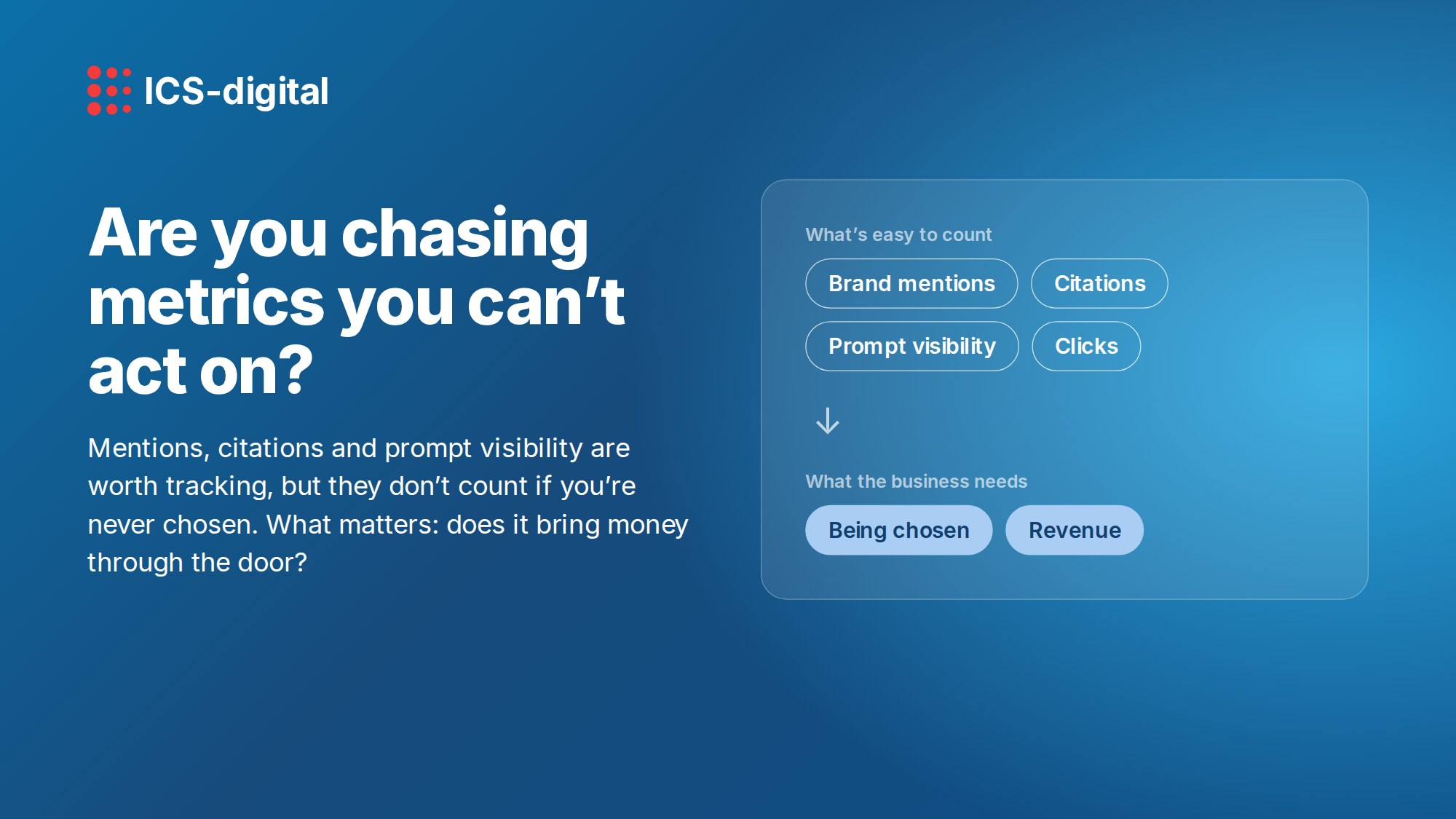
- Mentions, citations and prompt visibility are worth tracking, but they only count if someone ends up choosing you.
- Every choice has three drivers: functional, emotional and social.
- Measuring decision distance means comparing an audience profile, built from customer language, with a brand profile built from your own content and campaigns.
- Language that appears often but doesn't convert usually points to friction or an unmet need.
- To prove impact, set a baseline conversion rate for each page type, then use causal impact analysis once changes go live.
Meet Giulia
Laura: Could you share a bit about your background and the work you do?
Giulia: My background is in neuroscience. I studied it at university, then moved to the UK to do research. The money was never enough on a partnership contract, so I ended up in SEO. Many of us end up in SEO in different ways, and I always enjoy hearing those stories.
From the start, I was interested in the human side of search: how people search, why they search and how we meet their needs. We tend to think we need to cater to the machines, whatever the latest model or engine is. But behind every query, there's a human trying to solve a problem.
I built my career in SEO, moved into search more generally and eventually into digital acquisition, with a strong focus on organic. Alongside that, I work with universities and brands on research into implicit decision-making. That means looking at how people decide in digital environments, and how search and trust are changing now that more of the journey involves machines. So I'm a neuroscientist who ended up working in marketing.
What is decision distance?
Laura: We connected after your Search Engine Journal article where you introduced decision distance. Could you tell us what it is?
Giulia: Decision distance formalises something I've been doing for all my clients: aligning brand and audience. In short, it's the distance between what you offer as a brand, and how you communicate it, and the things that drive a decision for the user.
If you ask someone what decision they made today, they might say they took the car instead of the train. We tend to think of decisions as things we can put into a sentence. But much of decision-making happens below the surface, often before we realise we're making a decision at all.
LLMs make that layer even less visible. The other day, I asked an LLM to recommend some shoes. It took my preferences, my history and my location, and gave me a selection I probably wouldn't have come across on a search results page. AI assistants now make that first layer of decisions for us, and marketers have lost sight of it. It doesn't show up in full in our analytics or our search data.
Decision distance takes the drivers most likely to lead to a decision, for a human and for a machine that mirrors human decision-making, and compares them with what your brand communicates. That shows you the gap, so you can work to close it.
The metrics that matter
Laura: In your article, you talk about traditional SEO metrics no longer being enough. Where are they still valuable, and where do people need to start thinking differently?
Giulia: I don't think we should get rid of traditional metrics. They were valuable before and they're still valuable now. Their limitation is that they show us the result of an action, the part that surfaces.
With LLMs, there's a long list of new metrics: brand mentions, citations, prompt visibility, prompt coverage. To be honest, decision distance is just another one. Businesses are treating these as targets, and we need to make some hard calls. Are they Pokémon Go measures, where you need to catch them all but don't know what to do with them?
Being visible is our job as search professionals. But we also need to influence choice, because that's what matters to the business. The number of brand citations doesn't count for much if you're never chosen.
As SEOs, we can get distracted by hitting one number. When you report your impact to the business, the real question is whether it brings money through the door. If it doesn't, your budget next year won't be the same. So traditional metrics stop being enough when the challenge is bringing in more revenue.
Laura: So many searches don't result in a click anymore. But was that traffic ever converting? It feels like a real mindset shift for SEOs.
Giulia: It is, and it changes how we work with other channels. When I started in SEO in 2017, attribution was simple: your Search Console data went into a dashboard and that was what you needed. Now much of what happens outside Google doesn't show up in the numbers.
I recently had a client where organic seemed to go down while every other channel picked up. Someone might see you on social, then arrive through paid or organic. The journey is so fragmented that it's hard to show impact. I don't have a perfect answer, because it often depends on how the whole business organises its analytics. But SEOs need to be collaborative and flexible. Our industry is good at that, as we've been used to algorithm updates almost every month.
How to measure decision distance
Laura: If someone wants to measure decision distance for their own brand for the first time, what steps should they take?
Giulia: Decision distance is a metric I've essentially made up, so there's no single right way to measure it. I have my own approach, but bear in mind that it's an estimate.
Start by defining the drivers you want to identify. As humans, we tend to make decisions based on functional needs, emotional states and social drivers. What do I need to achieve? How will it make me feel? What do other people do?
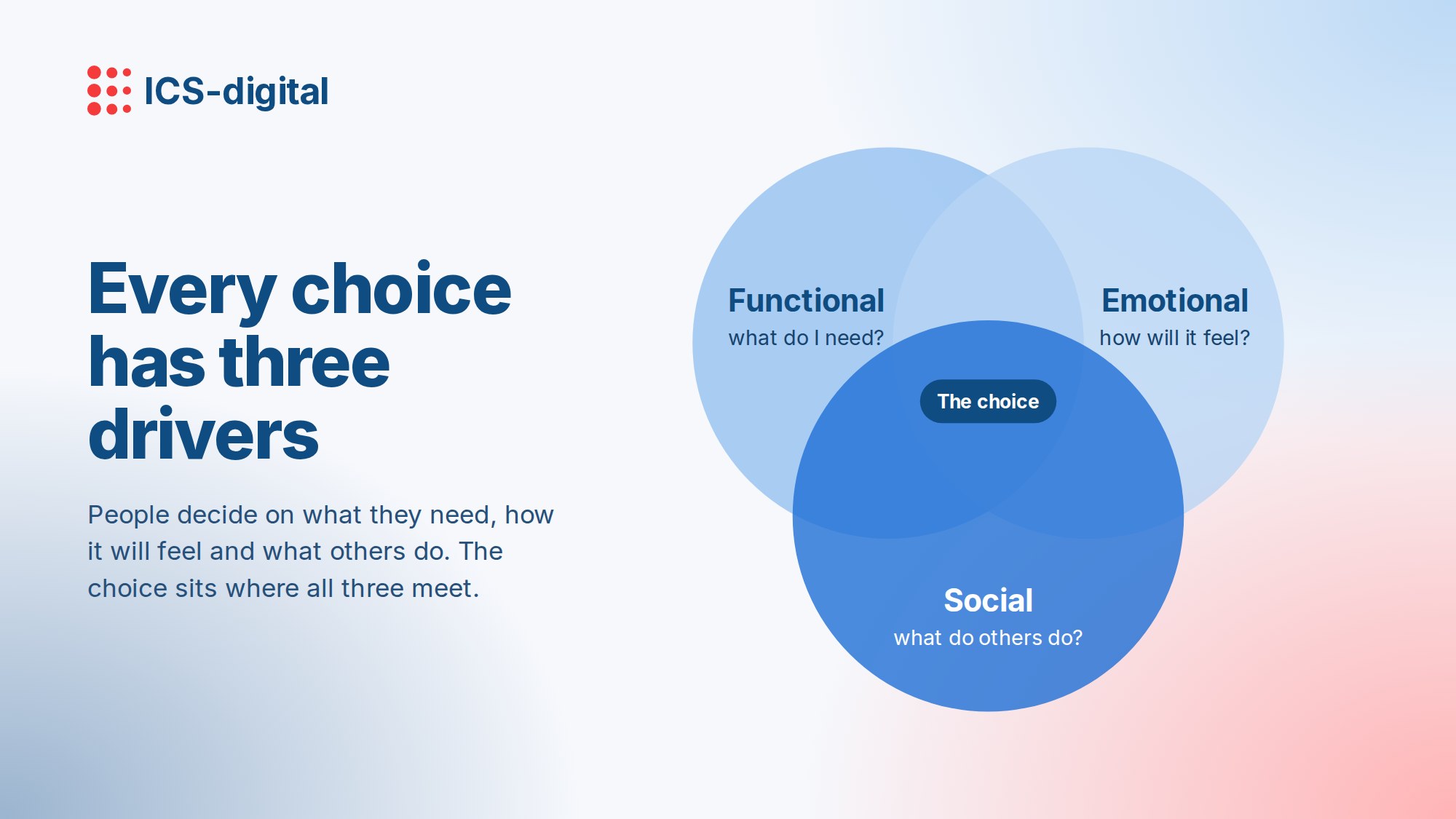
Then break each one down. A functional driver might be value for money. On the emotional side, trust is a big driver, and it's especially visible right now. Social proof matters because people want their choice validated by someone else.
Make a list of the things your audience makes choices on. It doesn't need to be sophisticated. Then give each driver a definition. Value for money means someone chooses something because they get an advantage over what it costs. Trust means someone wants to feel safe in their choice. These definitions are the base of the calculation.
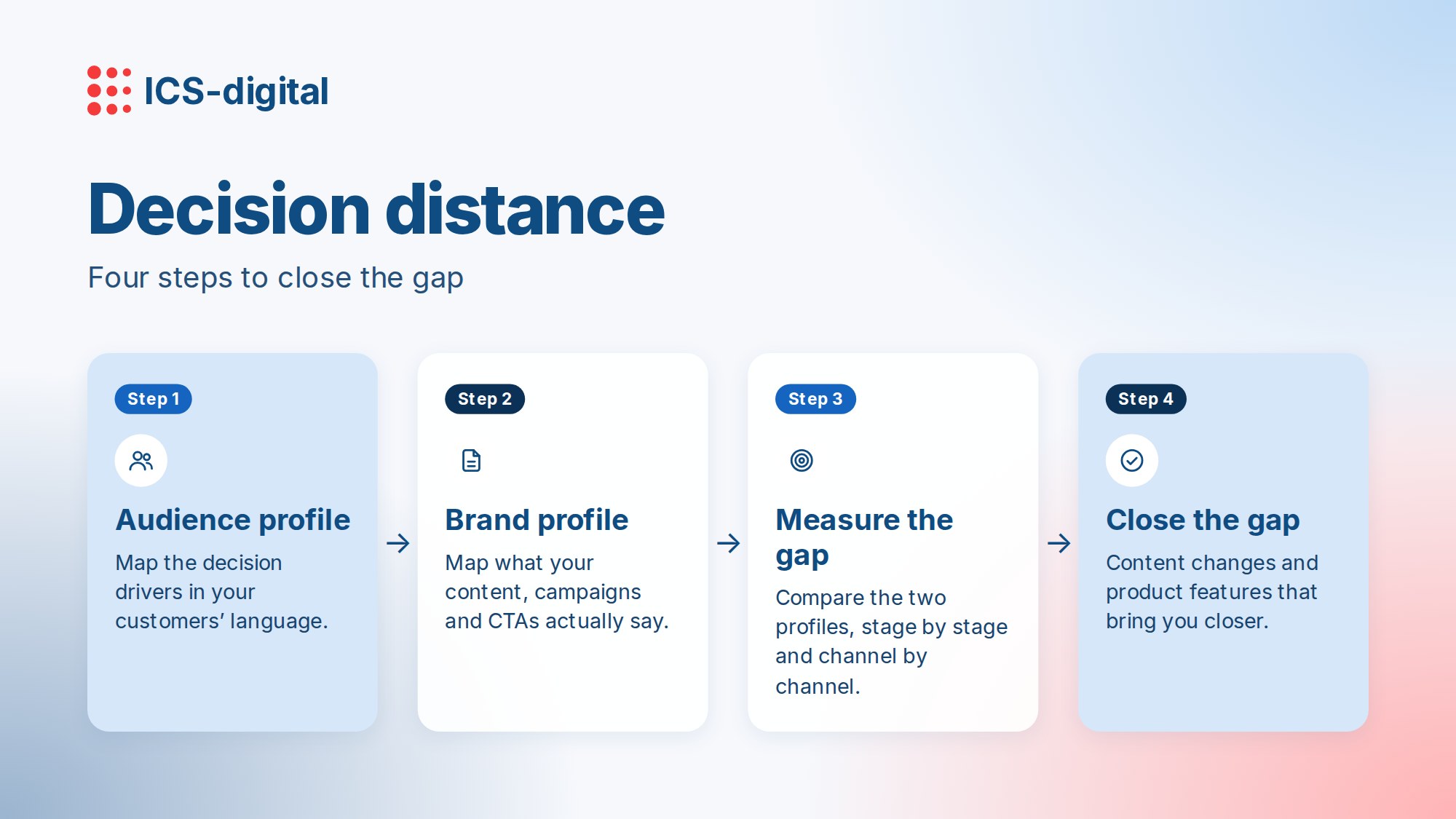
Next, build an audience profile from customer language. I have to say this to a lot of SEO people: don't only use queries from Search Console or your keyword tool. Customer language lives across the business, in customer interviews, chatbots, the help desk and CRM data. Chatbot conversations are a goldmine.
Where the data comes from tells you where it sits in the customer journey. Search and social data usually fits the awareness stage. Help desk data comes from people who have already made a choice, so they're in consideration, post-purchase or moving towards loyalty. You then find the strongest driver at each journey stage, based on how closely the language matches your driver definitions.
For example, a query like "Is this company reliable?" or "Where are they based?" tells me someone wants to feel safe in their choice. They trust what's familiar. Based on how we defined trust, that language sits under the trust driver.
Step two is building your brand profile. Take all the content you can, beyond SEO data and metadata: paid media calls to action, email messaging and anything else that covers the journey. Using semantic similarity, work out the strongest driver at each stage and in each channel.
Step three is comparing the two profiles. Say the strongest driver at the awareness stage is trust, but your brand campaigns and homepage focus entirely on functionality with no trust signals. That's misalignment. How you score the gap depends on how you defined the drivers and how you score on each profile. The bigger the gap, the bigger the misalignment.
Step four is closing the gap. That can mean content changes, but also feature requests to your product team. We often think search work is limited to content and small updates. Sometimes the fix needs something more substantial, which can bring in more revenue. So it becomes a cross-functional programme.
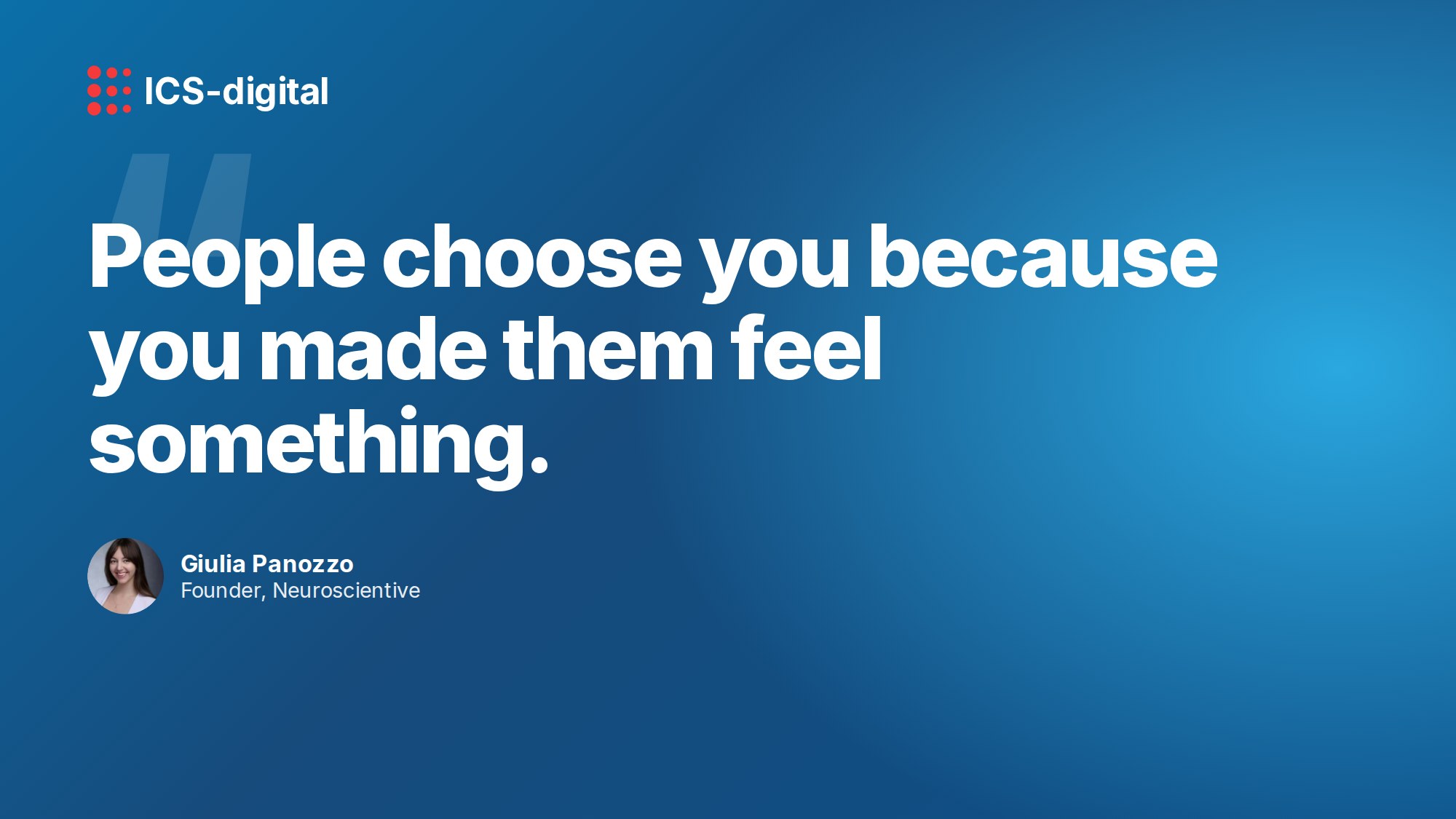
Many brands in the age of AI try to be as visible as possible, then forget they're still trying to be chosen and remembered. People choose you because you made them feel something, and machines try to mirror what people do. If people don't choose you, maybe you made them feel a way they didn't want to, or you didn't meet a functional need.
Smaller brands might not have much data, but that's no reason to skip this. Use a competitor's. If your audience data matches a competitor better than it matches you, you know you have work to do. At its simplest, the question is whether you're clear on who you are as a brand, who you cater to and how you do it.
Brands spent years trying to stand out. Now everyone is chasing the same metrics, and we're forgetting there are people to bring in.
Telling real drivers from noise
Laura: If similar language keeps coming up in the data, how do you tell a genuine decision driver from something that just appears a lot?
Giulia: You can work backwards. If language appears often but doesn't lead to clicks or conversions, it probably reflects a need that isn't being met. That's friction, and friction leads to inaction. So use common sense: does this sound like something that leads to action, or does it sound like a problem?
It also comes down to understanding your users. As an industry, we've built personas around job, location and age. Two people might be the same age and live in the same place, yet make different decisions. Their circumstances, values, emotional states and cultural context can all differ.
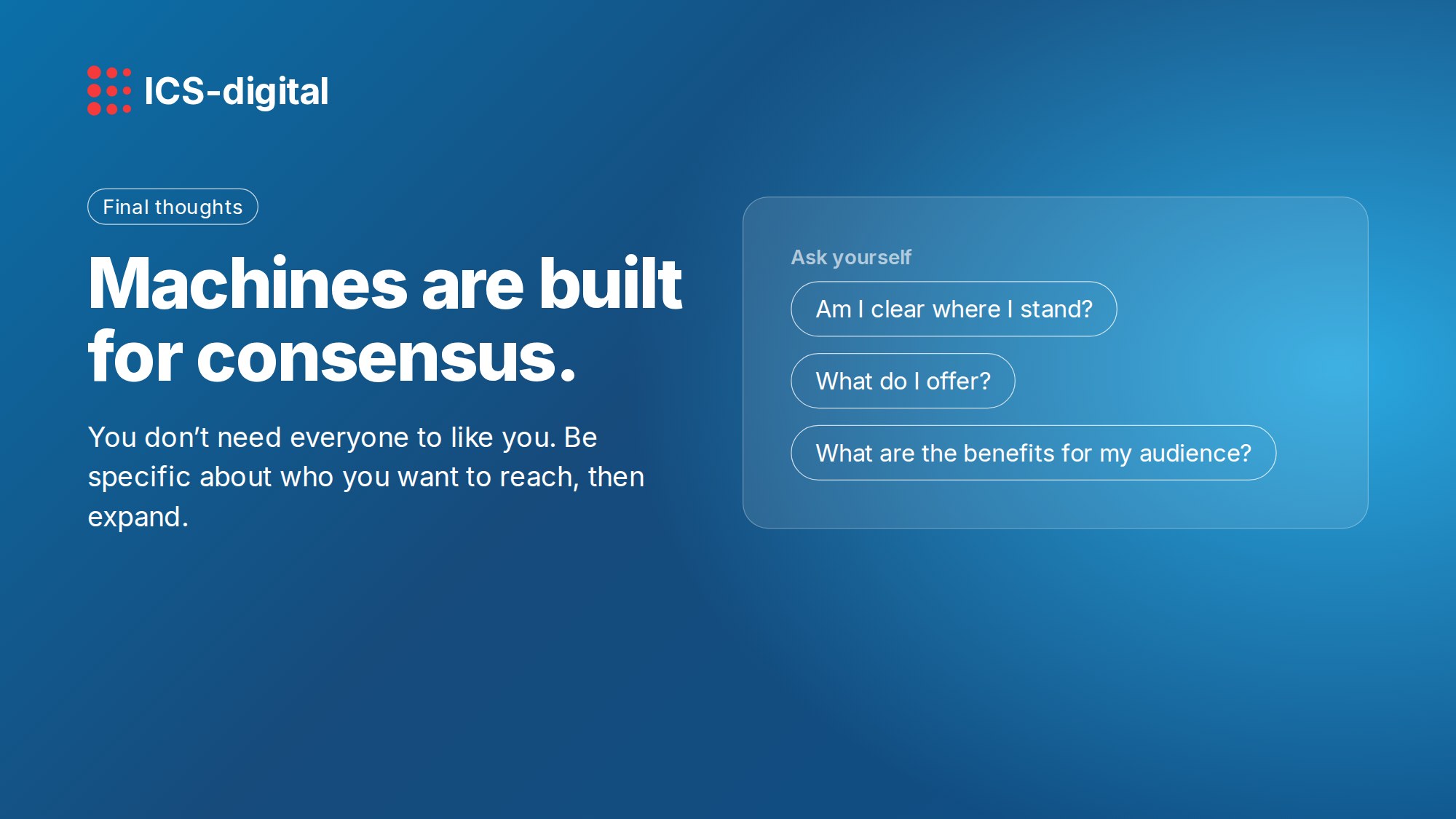
You can't cater to everyone, and you don't need everyone to like you. Machines are built for consensus. Be specific about who you want to reach. Growth now is less about casting a wider net and more about focusing on certain lanes. You can explore others later, but first you need to really know that audience.
Being relevant and distinctive
Laura: At ICS, we've been looking at distinctiveness, the idea Byron Sharp made famous in How Brands Grow. Brands use it to build mental availability in people, and we think it can also build retrieval availability in machines. Is it possible to balance relevance, speaking your customers' language, with standing out as a distinctive brand?
Giulia: I think so, but how you do it depends on the business and how it works with other channels. You might have a very distinctive brand identity, but if teams don't communicate it consistently across every medium, it comes out fragmented. That means alignment with your audience and alignment within the business. It tends to get lost when brands expand and try to do too much.
I have another framework called REM, for relevance, being everywhere and being memorable. The core idea is to make it about your audience rather than about you. When brands work hard on their identity, they can end up talking at people, while the audience is thinking, "That's not what I need."
To be retrieved by machines and people for one or two characteristics, you need to repeat them all the time, in different ways. A bit of variation is fine as long as it communicates the same core identity. The irony is that we're trying to be distinctive while also building consensus within the small environment people search in.
Proving commercial impact
Laura: Say someone finds a gap and updates their content, their homepage or even the product. How soon would they expect to see an impact on commercial outcomes?
Giulia: It depends on current traffic. SEO changes are slower, because traffic already takes time to move and revenue takes longer still. Product features show impact much faster.
Always start with a baseline. Good brands will have a decision matrix where changes must be justified before they're taken on. If you're suggesting content changes on specific pages, ask your analytics team for the conversion rate of each page type. For one client, I built an impact forecast tool with a conservative, medium and ambitious lift for each page type. That gives you guardrails, helps you get buy-in and gives you something to compare against later.
After changes go live, I use a model called causal impact. Plenty of tools now do it without you having to open RStudio. It measures the effect of a change against what performance would have been without it. That works even for a product feature launched after an SEO recommendation, where you have no control group, only before and after.
It's about being commercially savvy and stepping outside the SEO bubble. If I ran this brand, what would I care about? What would it take for me to sign off? We've talked a lot about language and people, but numbers still drive buy-in.
One thing to do tomorrow
Laura: If someone listening wants to start thinking this way tomorrow, what's one thing they could do?
Giulia: Ask yourself three questions and be very honest about the answers. Am I clear where I stand? What do I offer? What are the benefits for my audience?
Once you've narrowed those down, you can start to understand who your audience really is. Some brands are just starting out and haven't found their audience yet. Alignment with customers' values is what drives conversion, and more than a single conversion: the set of experiences that leads to loyalty.
Our work tends to focus on single interactions. But it's the build-up of interactions over time that shapes an identity and how people, and machines, remember and retrieve you.
Listen to the full episode
Hear the full conversation between Laura and Giulia on the Everything Digital Podcast, also available on Spotify and Apple Podcasts.
Giulia's Search Engine Journal article on decision distance, including the script she uses to measure it, is a good next step if you want to try the method yourself.
Similar Posts