


State of Marketing: 2026 is Not About More AI, It’s About Better Decisions

From evolving media landscapes, shifts in not only what audiences expect but also how they search, and, of course, AI and new technologies, brands are under constant scrutiny and pressure to stay ahead of the curve and prove the value of digital marketing activities. However, while this era of communication is more complex, the future of marketing can no longer rely on isolated strategies. To move forward, integrated marketing services are needed to deliver measurable outcomes at every level.
AI in marketing strategies is also set to be a key function in 2026, but at the same time, will marketing demand humanised strategic thinking to make these technologies truly effective?
To support this shift, ICS-digital’s senior leaders have shared their perspectives on marketing trends in 2026, bringing together their expertise across SEO, PR, Paid Media, Creative, Translation and Talent.
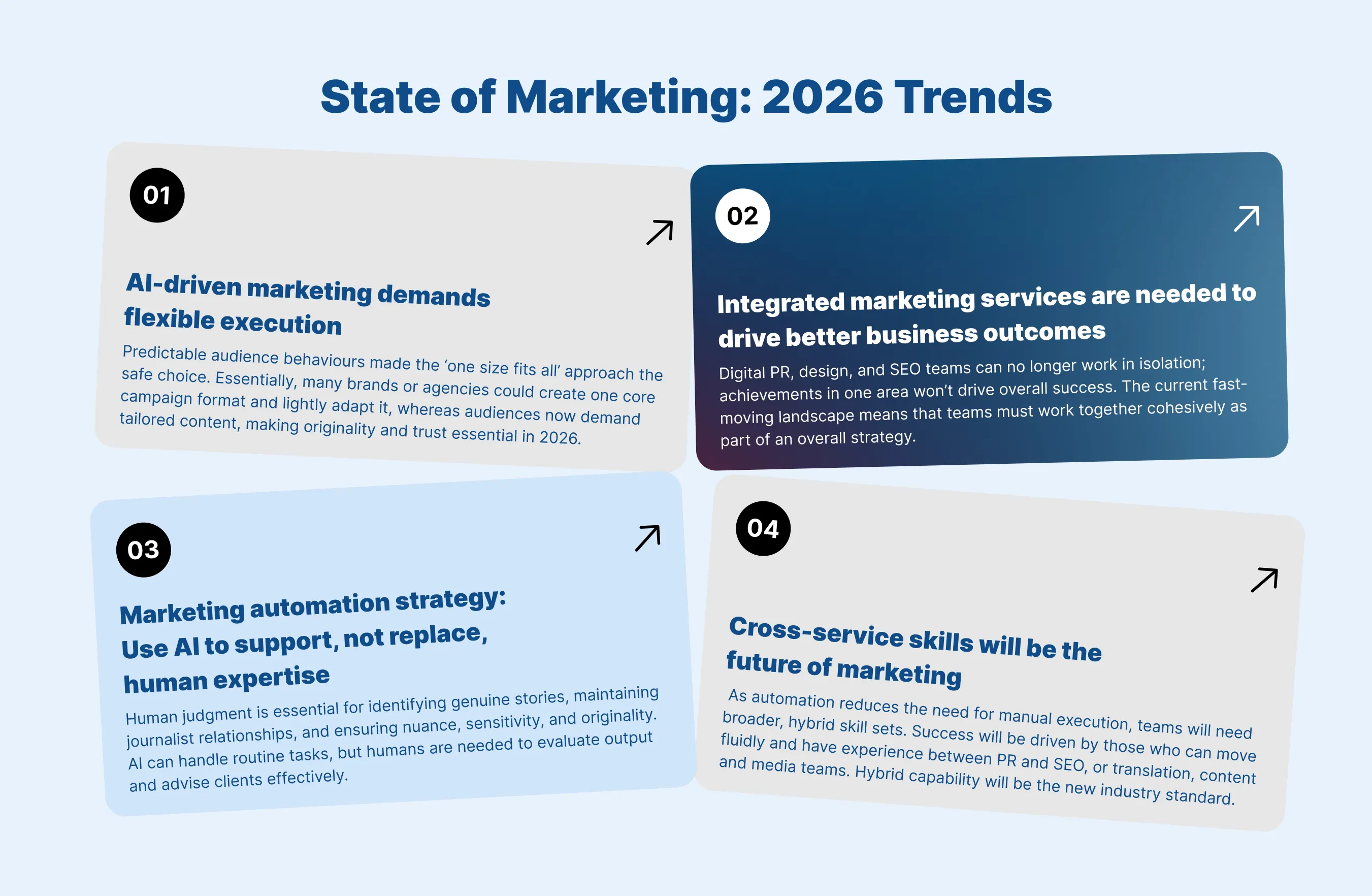
AI-driven marketing demands flexible execution
A few years ago, many brands and agencies were successful in creating one story or message and making only light adaptations, or rolling out a particular strategy across multiple channels. Platforms and audiences behaved more predictably, whereas in an AI-mediated environment, each space demands something different.
Chloe Thompson, Digital PR Lead, explains why this shift is happening:
“Regarding PR, the traditional ‘one story fits all’ approach will no longer be effective. Audiences are now split across countless platforms, and with many publications cutting back on journalists this year, each space demands something different. A story that worked a year ago, even for a similar client, likely won’t work today. For example, we are seeing a decline in regional publications, so a big city index might not land as well in 2026. This year, success will depend on highly tailored stories around the individual client: their expert voice, their customer base, and the data they uniquely hold.”
As audiences evolve to wanting more highly tailored stories, trust becomes an escalating challenge, notes Chloe Thompson -
“We’re already seeing PR teams, agencies and brands deploying questionable ‘experts’ or AI-generated spokespeople to gain coverage. In 2026, trust won’t be a nice-to-have. It will be the currency of credibility.”
At the same time, the growth of AI-driven marketing and marketing automation strategies is raising the bar for originality. Distinct experiences will carry more weight, which is already influencing how content is valued through SEO. Beth Hamby, SEO Manager, highlights the growing importance: “First-hand experience (the E in E-E-A-T) is becoming evermore important as it provides context & opinions that cannot be found in summarised AIOs.
Publishers are also subject to a reduction in clicks due to increased AIOs on SERPs. It is important that content strategies take into account how they can rank in these summaries as well as considering the individual value they can provide for users who do click through onto the site.
To rank in AIOs, it is valuable to provide context around any brand mentions (e.g., explaining that ‘Plarium is a game developer and publisher of popular games such as Raid Shadow Legends’, rather than simply describing them as ‘Plarium, a gaming company’. To maintain value for users, again, firsthand experience is key.”
The same principle is emerging in digital experiences and design. As part of a broader marketing operations evolution, standardised and familiar layouts are giving way to more adaptive systems that can be flexible across different user platforms or if used in a different context.
Jack Mattison, Senior Design Specialist, sees this as a defining change to marketing trends in 2026:
“We’re seeing a slow decline of ‘one size fits all’ UI and UX design and the more traditional website layouts we know and love are growing less popular. This is perhaps being replaced by generative UI layouts that we are seeing in Gemini 3 Canvas and GPT 5.1. Additionally, there will be a change from thinking of design as feature-led to outcome-led. E.g., I don’t want a new page on my website, but instead I want X number of contact form submissions.”
Altogether, strong brands still need to have a consistent strategy, but the most effective organisations will be those who are flexible with their execution depending on audience, platform, and the moment.
Integrated marketing services are needed to drive better business outcomes
Just as the one-size-fits-all uniform approach to messaging is breaking, a siloed approach to strategy is not far behind. In practice, this means that digital PR, design, and SEO teams can no longer work in isolation; achievements in one area won’t drive overall success.
The current fast-moving landscape means that teams can no longer work in isolation and must work together cohesively as part of an overall strategy.
Chloe Thompson, Digital PR Lead, makes it clear that isolated success is no longer enough:
“When planning for 2026, it would be wrong for brands to only focus heavily on link counts as their measure of success.” Instead, Chloe argues, PR coverage must service a broader purpose. “Links must be part of a broader, connected strategy-one that spans many services all working to one overarching business goal”.
For example, if a brand were launching a new product, each backlink from PR efforts would be aimed towards the target category page, using services like social and paid media to amplify this effect. Ultimately, all channels would then be supporting one overarching goal of increasing traffic to the category page and driving revenue for the new product.
Creative thinking is also evolving in the same direction.
Jack Mattison, Senior Design Specialist, highlights that branding needs to follow a holistic strategy -
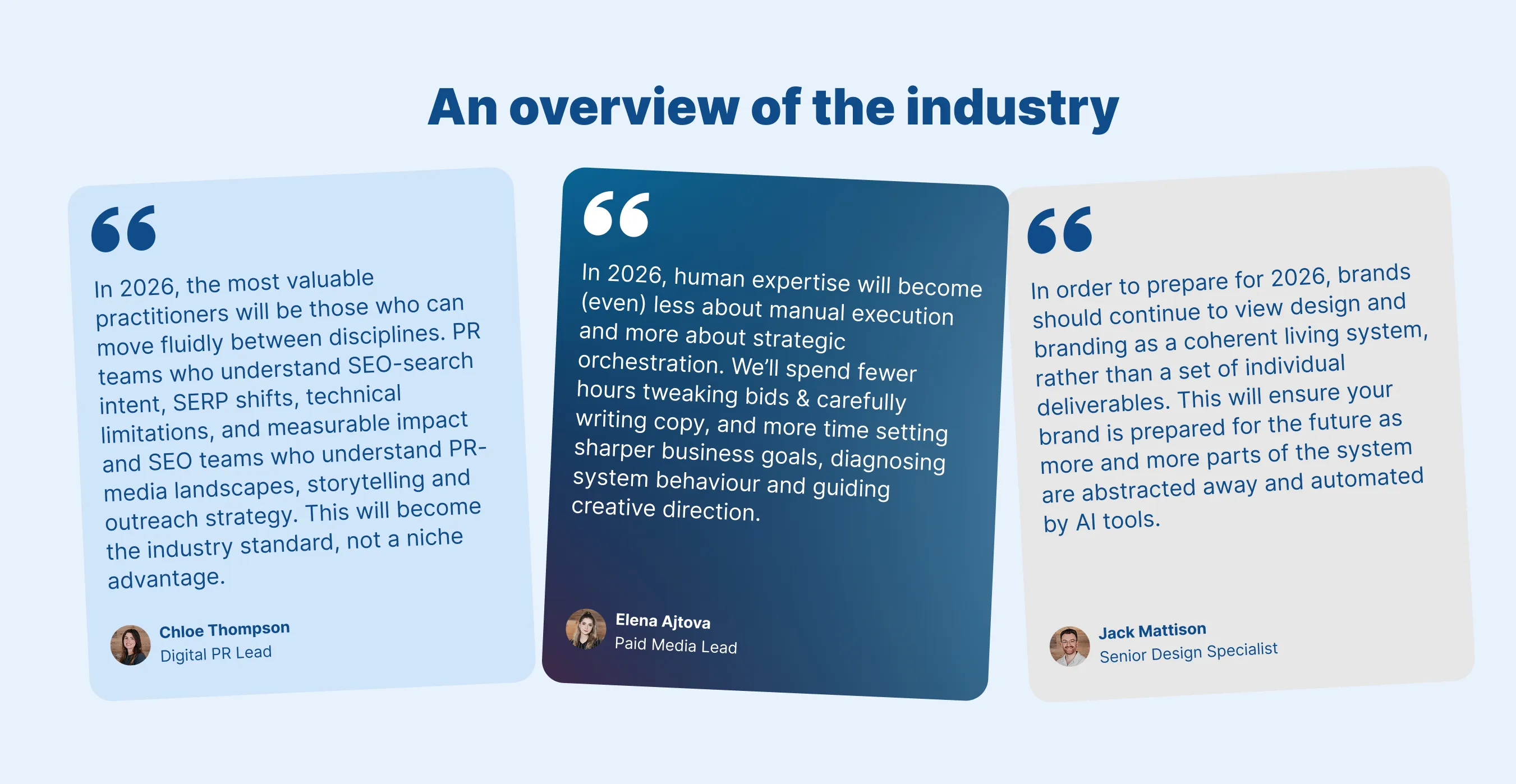
“Continue to view design and branding as a coherent living system, rather than a set of individual deliverables. This will ensure your brand is prepared for the future as more and more parts of the system are abstracted away and automated by AI tools.”
In advertising and paid media, automation is pushing marketers away from channel-level control, which makes integration essential rather than an optional approach. “The fight for performance will no longer be won in platform settings, but in the strength of your organisation’s data ecosystem and your ability to feed the algorithm what it needs to make good decisions, says Elena Ajtova, Paid Media Lead -
“What the algorithm defines as best, however, is still almost entirely within marketers’ control. Instead of manual bids & carefully written copy, ensuring effective control over your Paid Media activity now increasingly means setting clear business objectives and providing high volumes of high-quality conversion data”.
Thus, the importance of cross-service marketing integration is ever-growing: “Paid Media can’t operate in isolation any more. Teams must understand how search, social, CRM, content, and offline activity influence one another - and build processes that encourage shared thinking, not siloed optimisation.”
Marketing automation strategy: Use AI to support, not replace, human expertise
While AI is modernising the approach towards marketing, there have also been questions raised in the industry around credibility and trust.
In Digital PR, Chloe Thompson has pointed out the risks for brand authority and how this might affect the future of marketing -
“With distrust rising and automation increasing, human judgement will be critical for spotting genuine stories and angles, building journalist relationships, ensuring sensitivity, nuance and originality, and navigating ethical grey areas in AI usage."
Even in translation, AI impact will continue to grow, but human expertise remains critical in marketing operations evolution, predicts Frances Hockin, Head of Linguistics: “AI-augmented machine translation will continue to gain ground in areas traditionally handled by human translators. Human expertise will increasingly focus on the evaluation of MT output and advising clients on how it can best suit their requirements.”
However, while the balance is shifting, it’s not towards replacement.
Elena Ajtova, Paid Media Lead, argues that “If 2025 taught us anything, it’s that AI can enhance outputs at scale but falters without informed oversight. In 2026, human expertise will become (even) less about manual execution and more about strategic orchestration.”
Despite technological advances, people remain central. It’s critical for the future of agency models to bring the focus back to human connection.
Robert Milner, Senior Talent Acquisition Manager, notes that “In the past year or so, we’ve seen new features implemented within Applicant Tracking Systems that crawl and summarise CVs (scoring the suitability of a candidate), and also seen the option of AI-generated job adverts. Whilst these features could potentially save some time, I personally wouldn’t rely on those to inform our hiring decisions. Hiring is about making personal connections.”
Ultimately, while AI will support with workflow, human connection will define quality.
Cross-service skills will be the future of marketing
While AI may mean the end of manual execution in the marketing space, marketers will still be challenged by the strength and reliability of their data inputs - from measuring first-party data to cross-channel insights. To stay ahead in translation, for example, “we need stronger machine translation post-editing quality frameworks, aligned with TAUS and ISO 18587 guidance, and for these to be applied more widely to better understand strengths and areas for improvement,” suggests Frances Hockin.
Alongside the need for data skill sets to evolve, Chloe Thompson, Digital PR Lead, predicts that marketers will need hybrid capabilities to deliver value. “To stay competitive, teams need blended knowledge. In 2026, the most valuable practitioners will be those who can move fluidly between disciplines.
This means PR teams that deeply understand SEO-search intent, SERP shifts, technical limitations, and measurable impact and SEO teams that understand PR-media landscapes, storytelling and outreach strategy. Hybrid skill sets will move towards becoming the industry standard, not a niche advantage.”
Rosie Gogoley, Senior Digital PR Manager, agrees - “There must be more confidence in providing multi-form content as clients become more cross-service with their strategies. Stronger ideation sessions must also aim to build work that feels fresh and tailored rather than from the same old playbook.”
In paid media, teams need to build capabilities in four core areas, says Elena Ajtova. “Data Literacy & Signal Architecture, AI-Native Creative Development, Cross-Channel Fluency, and Strategic Interpretation of AI Outputs.”
“What does this mean in practice? Having seen the disastrous effects that poor creative execution can have, marketers have been wary of adopting or even experimenting with platform-generated creative, and for good reason… until now. Recent advancements in image & video generation have improved the technology far beyond the early days of Performance Max auto-generated assets - with extensive testing now placing the performance of AI-generated creative almost on par with that of human-created versions.
“But there is one key caveat that ought not to be dismissed. As with all things AI, the quality of the creative output is heavily dependent on the level & quality of brand context provided and the quality of the prompting instructions given.”
Looking Ahead
Overall, we've seen some big shifts in marketing trends in 2026 and an evolution when it comes to how consumers are searching and how brands need to show up.
Across the board, it's clear that thinking beyond the day-to-day tactical execution in your service specialism is no longer a nice-to-have - to get ahead in 2026, you have to be thinking about the whole ecosystem. It's no longer just about 'is my brand ranking?', but 'is my brand trusted?', 'is my brand being talked about?' and 'will a consumer choose my brand over a competitor?'
The year ahead will definitely bring fresh challenges when it comes to digital marketing strategy, but brands should be excited to test and learn and try new avenues to drive growth, whilst not forgetting about the fundamentals of organic and paid search visibility.
The key lessons are that success cannot be driven by generic approaches or isolated campaigns. To deliver impactful results, marketers must combine AI in marketing strategies alongside cross-service marketing integration and human insights to fuel an adaptable approach across many platforms.
Similar Posts





.jpg)